
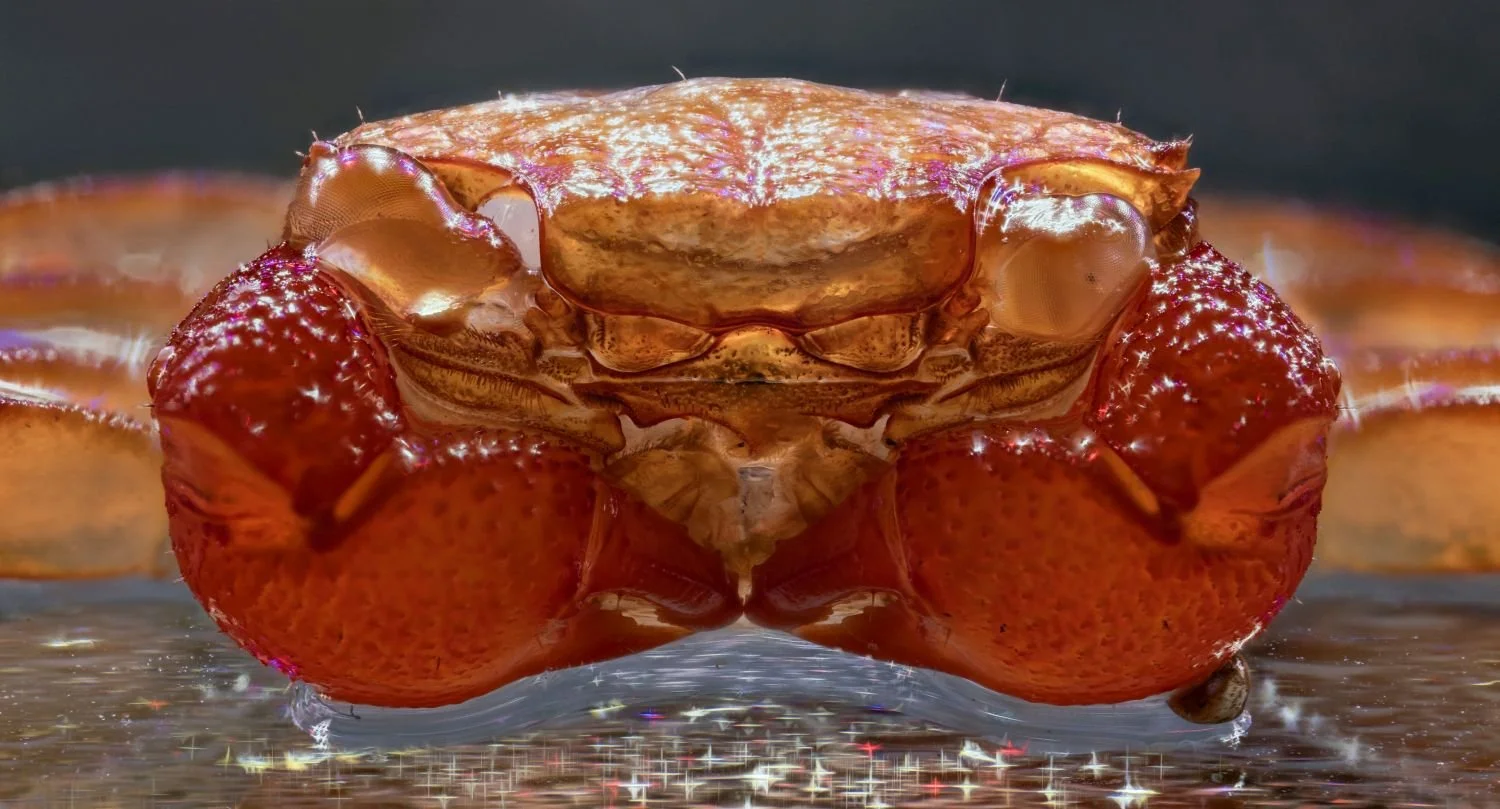
In order for Geosesarma Vampire Crabs to grow, heal injuries, and regrow lost claws, they must undergo one of the most perilous biological transformations on earth: ecdysis (molting).
For keepers, molting is often a source of intense anxiety. Crabs will suddenly vanish for two weeks at a time, look motionless and pale, or leave behind an exact duplicate "ghost crab" that looks terrifyingly like a corpse. Worse still, when a molt goes wrong—a medical condition known as dysecdysis—the crab can become hopelessly trapped inside its own calcified armor. In this masterclass guide, we explore the science behind the crustacean molt cycle, examine what causes failed molts, outline how crabs regenerate lost limbs, and show you exactly how to tell an empty molt from a deceased crab.
Vampire Crab Molting Masterclass: Dysecdysis, Stuck Shells & Regeneration
Vampire Crab Molting FAQs
How do you tell if a vampire crab is dead or just molting?
A discarded molt is completely hollow, papery, translucent, and features empty eye sockets with an open rear carapace flap. A dead crab is solid, heavy, has opaque eyes and flesh inside the shell, no open rear hatch, and will produce an unmistakable ammonia or rotting fish odor within 12 to 24 hours.
Jump to: Molt vs Dead Identification →Can you leave discarded crab molts in the water?
Yes, absolutely! Discarded molts are made of pure chitin and calcium carbonate, not decomposing meat. They will not foul your water or cause ammonia spikes. Leaving them in the water gives crabs, shrimp, and snails an essential mineral boost as they consume the shell to recycle calcium.
Jump to: Mineral Boost & Water Molts →Do vampire crabs molt on land or in the water?
Almost all Geosesarma species (including Purple Vampire Crabs and Red Devils) molt fully submerged in the water section. The only currently known exceptions are Geosesarma notophorum (White Mandarin), Geosesarma pontianak, and Geosesarma sp. 'Purple Haze', which molt on land. However, carcinologists believe several unstudied wild species may also molt terrestrially.
Jump to: Water vs Land Molters →Why do vampire crabs disappear for weeks at a time?
Before and after molting, vampire crabs hide inside deep subterranean burrows or dense damp moss for 7 to 14 days. During this period, they soften their exoskeleton, undergo ecdysis, and wait for their new cuticle to harden to avoid being attacked or cannibalized by tank mates while soft.
Jump to: The 4 Molting Stages →Can you help a vampire crab that is stuck in its molt?
In almost all cases, physical intervention with tweezers does more harm than good. A crab's new body is jelly-soft; pulling on stuck limbs or carapaces usually tears internal organs, ruptures gill structures, or causes fatal hemorrhaging. If a crab cannot free itself within 12 to 24 hours, the outcome is usually fatal.
Jump to: Can You Help a Stuck Crab? →Can vampire crabs regrow missing claws and legs?
Yes. Vampire crabs possess remarkable regenerative abilities. When a limb is lost, a specialized blastema (limb bud) forms at the base. Over the next 1 to 2 molts, a fully functional, miniature replacement claw or leg expands and hardens, reaching full adult proportions after subsequent molts. However, eye injuries cannot regenerate.
Jump to: Claw Regeneration Biology →The 4 Stages of the Vampire Crab Molting Cycle
Because arthropods possess a rigid exoskeleton composed of crystalline chitin and calcium carbonate, they cannot grow continuously like mammals. Instead, expansion occurs in discrete episodic leaps governed by the crustacean molting hormone (ecdysone). Carcinologists divide this into four distinct phases:
1. Proecdysis (Pre-Molt Preparation)
Days or weeks before shedding, the crab begins reabsorbing calcium from its existing endocuticle into its hemolymph (blood) and specialized internal storage organs (gastroliths). Externally, the crab's colors fade into dull, muted tones. The crab becomes reclusive, stops foraging, and retreats into a humid subterranean burrow or hovers along shallow water edges to hydrate its branchial tissues.
2. Ecdysis (The Shedding Event)
The actual molting event occurs remarkably fast—often taking between 15 and 45 minutes. The crab takes in air or water to dramatically increase internal hydrostatic pressure. This bursts open the posterior suture line (the ecdysial seam) where the carapace meets the abdomen. The crab carefully extracts its walking legs, chelipeds, mouthparts, and even its delicate branchial gill linings, backing out through the rear gap like an astronaut leaving a spacesuit.
3. Metecdysis (Post-Molt Expansion & Hardening)
Immediately following emergence, the crab is known colloquially as a "jelly crab." Its new cuticle is soft, flexible, and completely defenseless. The crab pumps water into its tissues to stretch its new shell by 10% to 20% before calcification locks in its new size. Over the next 48 to 72 hours, it mobilizes stored calcium to harden the new armor. It remains in deep seclusion during this window to avoid being cannibalized.
4. Anecdysis (Inter-Molt Normalcy)
Once the shell is rock-hard, vibrant coloration returns. The crab resumes active territory defense, emerges to forage greedily to rebuild depleted energy reserves, and will usually consume its own cast-off molt to reclaim vital minerals.
Where Do Vampire Crabs Molt? Water vs. Land Molting Species
A crucial biological detail that many keepers overlook is where their crabs actually perform ecdysis:
The Rare Land-Molting Exceptions:
There are three fascinating exceptions in the genus that defy this rule and molt exclusively on land in damp moss or humid burrows:
- Geosesarma notophorum (White Mandarin Crab)
- Geosesarma pontianak
- Geosesarma sp. "Purple Haze"
These specialized species have evolved biological adaptations that allow them to hydrostatically swell their cuticle using air pressure and moisture absorbed from humid soil, completely avoiding the aquatic basin during ecdysis.
Carcinological note: Because the vast majority of Geosesarma species endemic to Southeast Asia have never been comprehensively studied or bred in captivity, it is highly probable that several other wild species also molt on land! If you keep an unclassified or rare color morph, providing both pristine shallow water and deep damp terrestrial moss ensures they can molt according to their specific evolutionary instinct.
Molt vs. Dead Crab: How to Tell the Difference 100% of the Time
One of the most common panicked posts in aquarium forums reads: "My vampire crab just died! It's lying stiff on the moss!" But in a massive percentage of these cases, the keeper is looking at an empty shell.
Because an exuvia retains the crab's exact shape, bristles, and coloration, it looks shockingly lifelike. Here is how to verify what you're looking at without guessing:
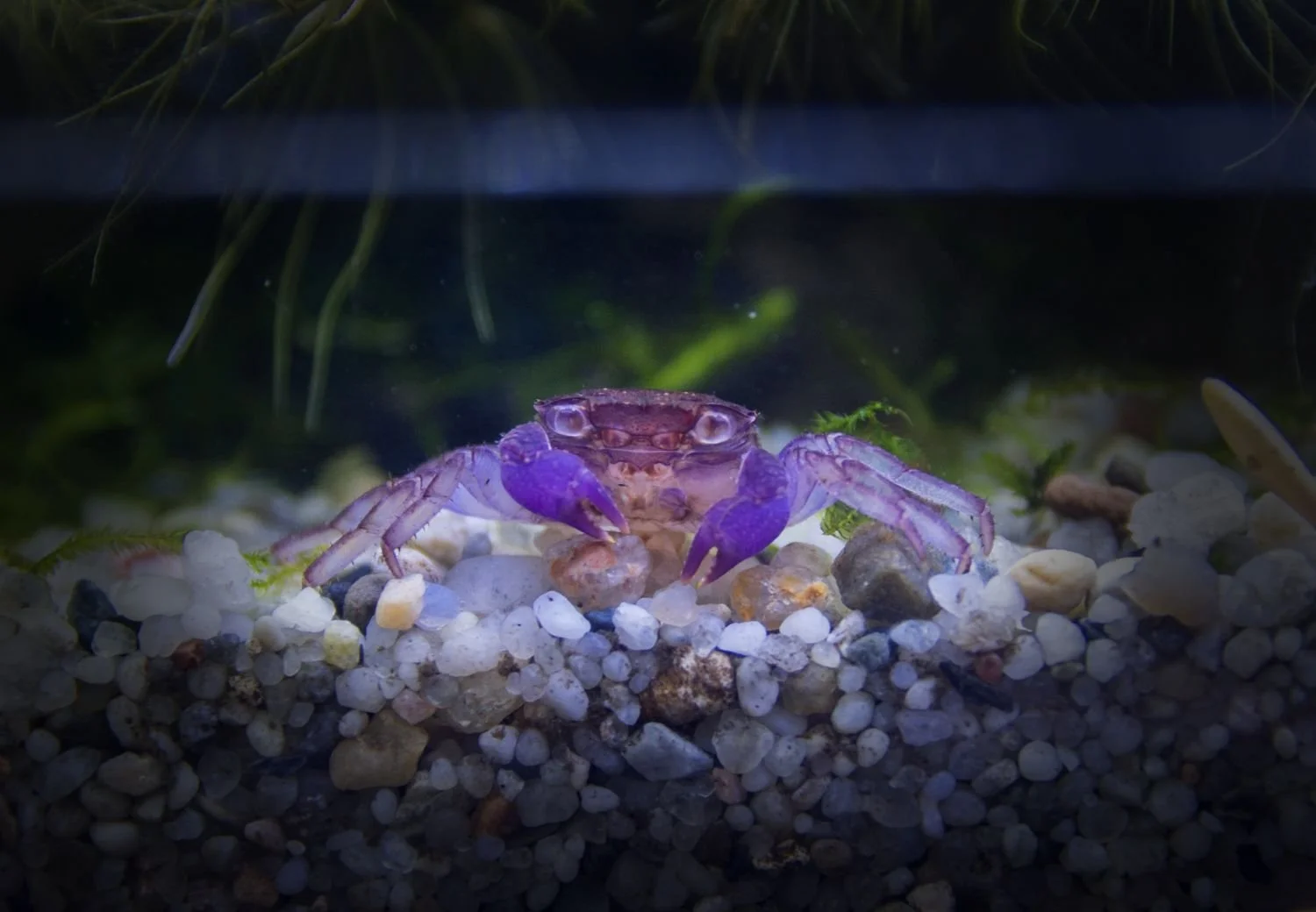
Picture: A perfect, complete exuvia molt from an adult Geosesarma dennerle. Notice how every delicate walking leg, claw tip, and eye stalk is preserved intact without flesh inside. (Jascha Lucas / The Indoor Ecosystem).
Picture: Macro view of an empty molt. Look directly at the eye stalks: they are completely clear and hollow inside where the living ocular tissue slid cleanly out.
The 4-Point Inspection Checklist:
- 1. The Eye Socket Test (The Smoking Gun): Look directly at the crab's eyestalks. On an empty molt, the cornea is completely transparent and hollow inside, looking like tiny glass tubes. On a dead crab, the eyes are dark, cloudy, opaque, and solid.
- 2. The Rear Carapace Seam: Gently inspect the rear of the main shell. A molt will have a gaping horizontal hatch swung open at the rear where the crab exited. A dead crab's carapace is tightly sealed to its thoracic sternum.
- 3. Weight & Density: Molts are paper-thin, feather-light, and translucent when held up to a flashlight. A deceased crab feels solid, heavy, and contains dense internal muscle mass.
- 4. The 24-Hour Smell Test: An empty molt has zero scent. A deceased crustacean decomposes rapidly in humid vivarium conditions, emitting an unmistakable, pungent ammonia and rotting fish stench within 12 to 24 hours.
Video: Molts vs Dead Crabs (How to Tell the Difference)
If you have an unmoving crab in your tank right now and need visual confirmation, watch this real-time breakdown comparing live exuviae against deceased specimens under macro magnification:
What Causes Failed Molts (Dysecdysis)?
When ecdysis fails, it is almost always catastrophic. The crab becomes physically wedged inside its old shell. As the timer ticks, the soft new cuticle begins to harden prematurely against the constricting walls of the old exoskeleton. Blood circulation to the limbs is cut off, and the crab suffocates as its branchial chamber remains sealed.
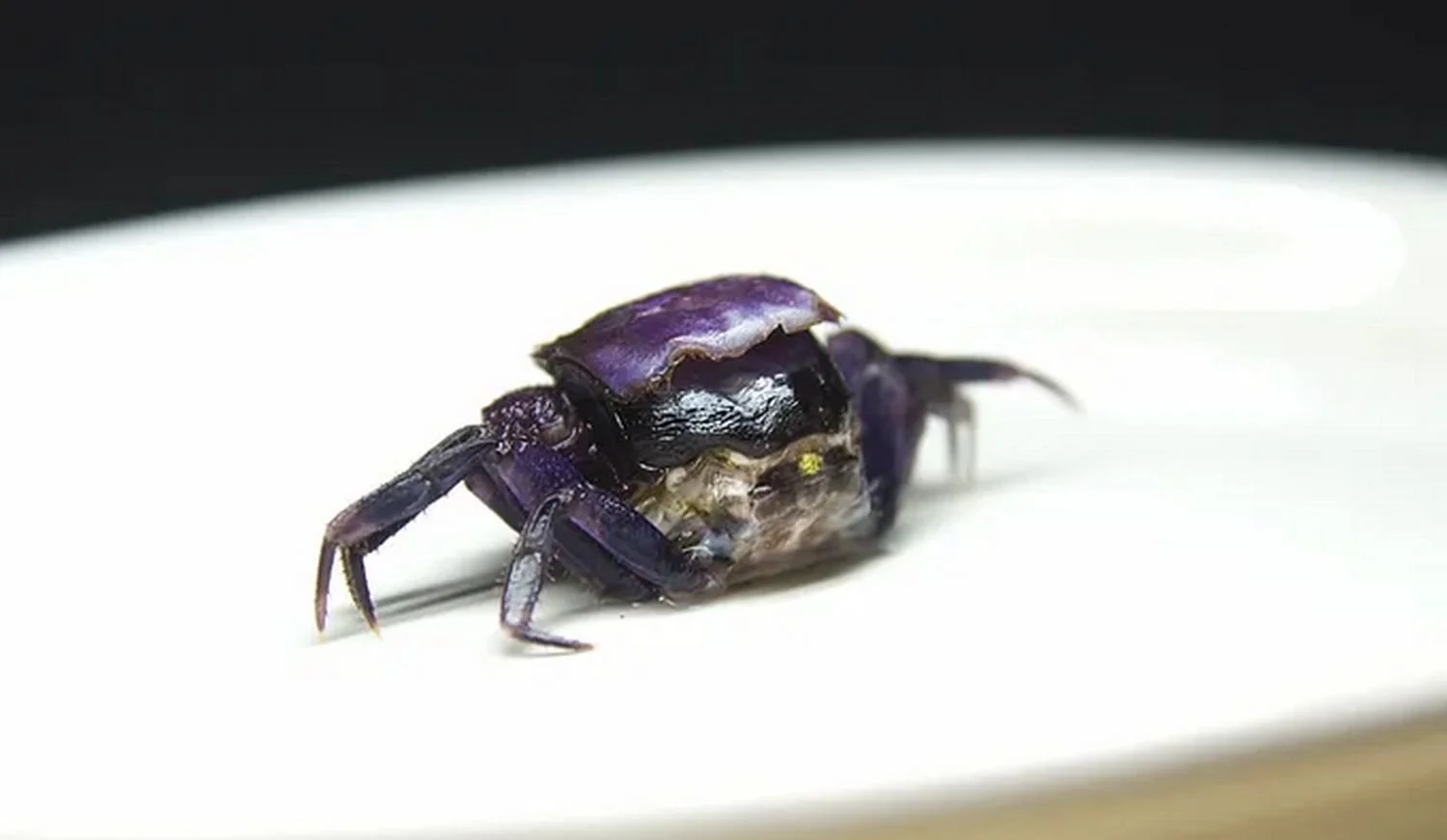
Picture: Rear view of a failed Geosesarma molt (dysecdysis). The posterior carapace split open, but the crab could not generate sufficient hydrostatic pressure to extricate its limbs.
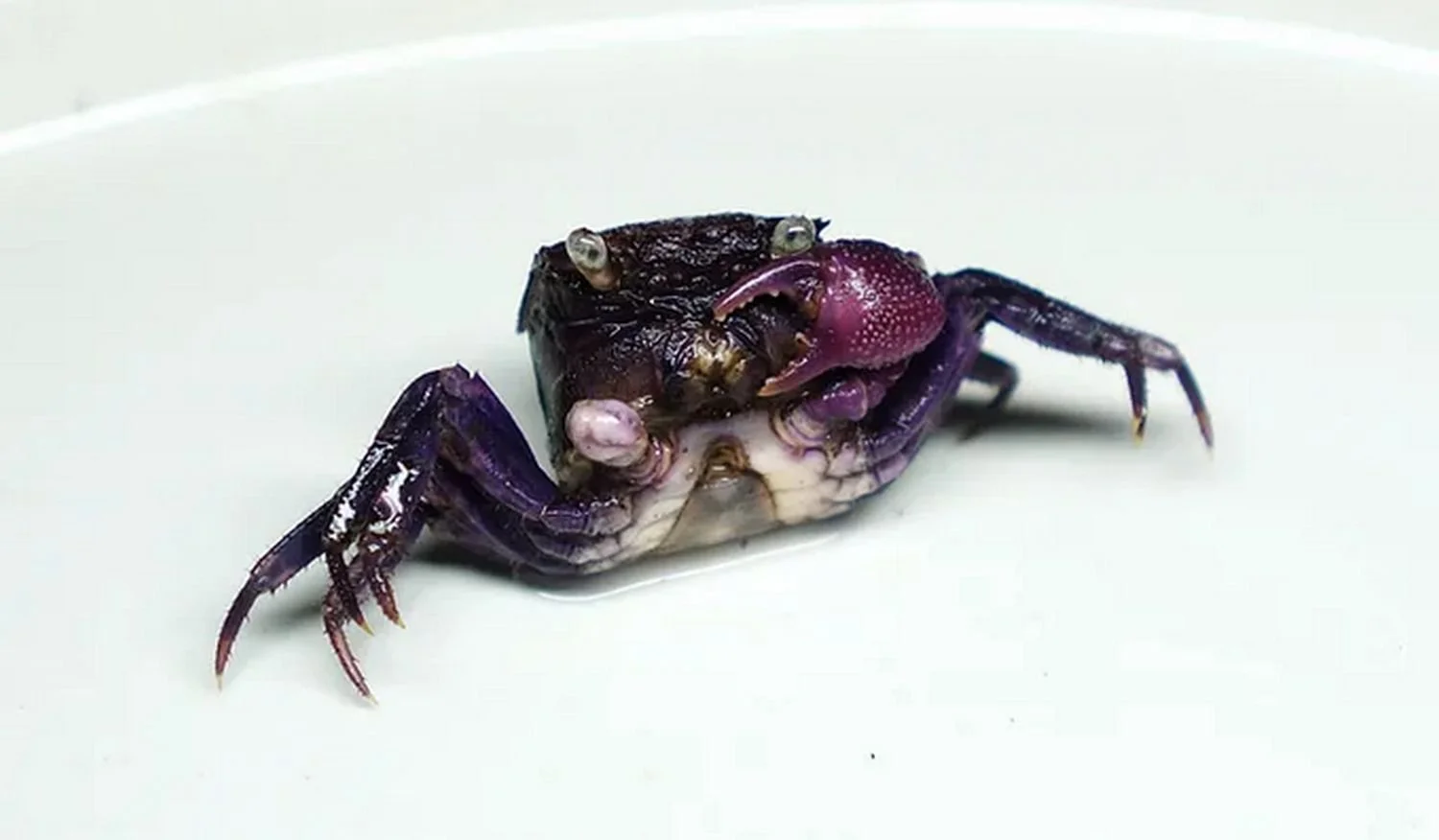
Picture: Front view of the same failed molt. Notice how the large chelae (claws) became wedged inside the old joint collars, preventing the crab from pulling free.
Primary Triggers of Dysecdysis:
- Calcium & Mineral Depletion: If water lacks dissolved general hardness (GH below 6 dGH) or food lacks bioavailable calcium, the crab cannot synthesize sufficient enzymes to separate the old cuticle from the hypodermis.
- Prior Battle Damage & Scarring: If an adult male has had a claw fractured, crushed, or improperly healed after a territorial fight, the swelling or deformed joint cannot squeeze through the narrow basal ring of the old shell.
- Low Relative Humidity (For Land Molters): For terrestrial molters like G. notophorum, if ambient air humidity drops below 75%, the exposed moist membrane dries out and acts like glue, trapping the crab halfway through.
- Physical Harassment: If an aggressive male or a swarm of crickets attacks a crab during ecdysis, the surge of panic hormones can cause the crab to abort the process mid-exit.
Personal Case Study: The Stuck Claw Tragedy
I’ve been keeping and breeding Geosesarma vampire crabs for many years, managing large colonies across dozens of paludariums. In well-maintained setups with proper water hardness and high-protein nutrition, failed molts are extraordinarily rare.
However, I documented a heartbreaking case that illustrates exactly how physical fighting connects to molting mortality:
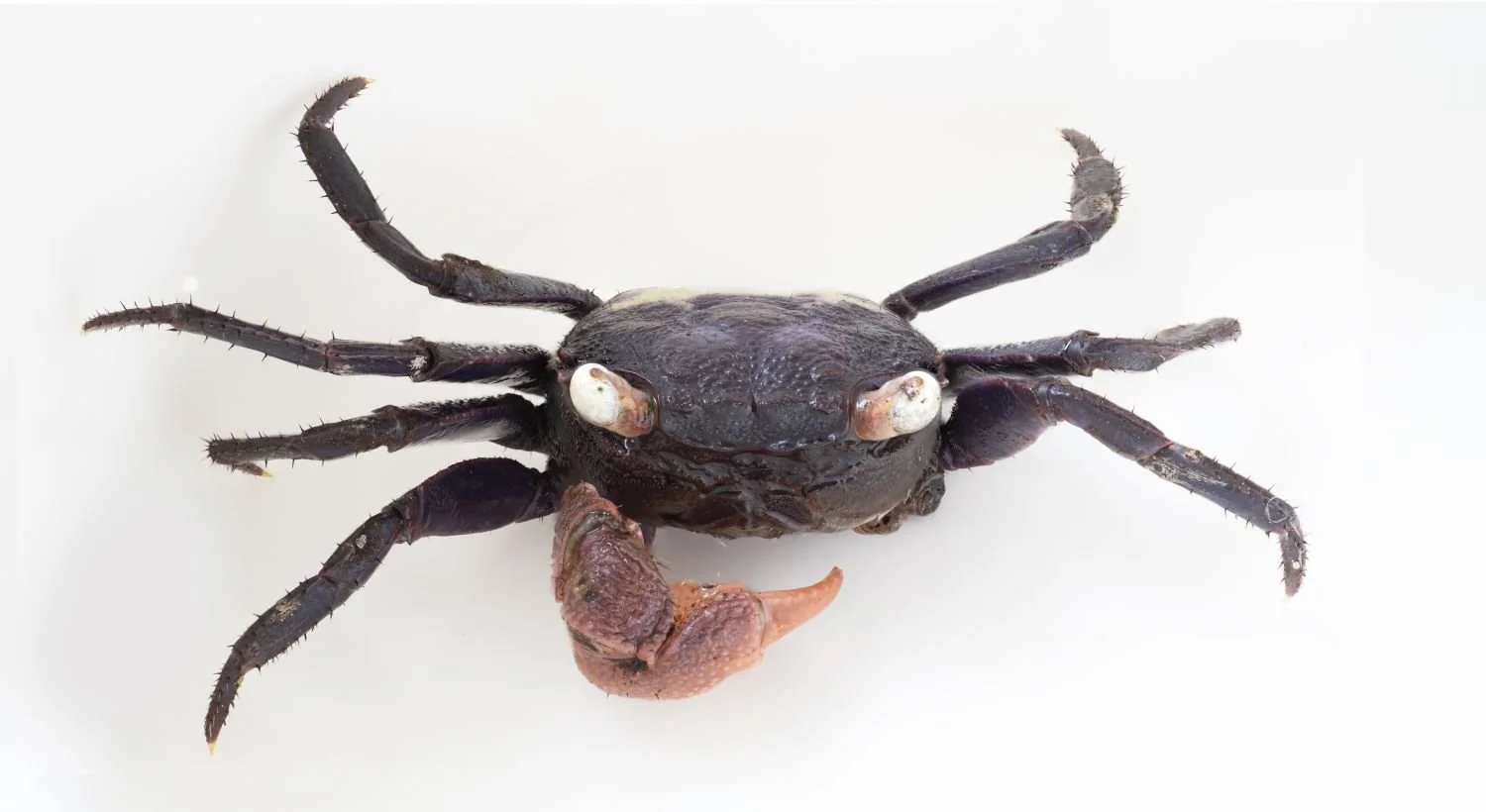
Picture: A male vampire crab that lost a claw and walking leg in a territorial clash. Fractured joints and scar tissue severely increase the risk of dysecdysis on subsequent molts.
The crab in question had previously engaged in a violent territorial skirmish with a rival male, suffering a severe fracture near the base of its right cheliped. When its molting cycle arrived, the crab successfully split its rear carapace and freed its walking legs, but the enlarged, damaged claw joint became hopelessly wedged inside the old pincer casing.
The crab was trapped for over 18 hours. I brought it under macro lighting and carefully assessed whether I could assist it, but the new cuticle had already begun cross-linking. Attempting to pull the claw would have disemboweled the animal. Ultimately, I had to make the difficult, humane decision to alleviate its suffering. This case proved that preventing territorial combat is just as vital for molting survival as water chemistry!
To prevent these territorial claw battles in your own enclosure, follow our guidelines on stopping vampire crabs from fighting.
Video: Vampire Crab Molting Problems & Failed Molts
In this video, I walk through the clinical details of this exact failed molt, explaining what warning signs to look for and why mechanical intervention is rarely possible:
Can You Help a Crab Stuck in a Molt?
Every keeper's natural instinct is to grab a pair of fine tweezers and try to peel away the old shell. In 95% of cases, you should not do this.
Why Tweezers Are Usually Fatal:
The newly emerged cuticle beneath the old shell is essentially a living liquid-gel membrane filled with pressurized hemolymph. There is no hard boundary between the crab's internal organs and its skin yet. Grasping the shell with metal tools applies shearing forces that tear the gills, rip off walking legs at the coxa, or cause massive internal hemorrhaging. Furthermore, the crab will thrash in panic, worsening the entrapment.
What You Can Safely Do:
- Boost Ambient Humidity to 100%: If the crab is molting on land, gently mist the immediate area with warm, dechlorinated RO water to ensure the lubricating fluids between the old and new shell do not dry out.
- Ensure Easy Water Access: If the crab is struggling near the shoreline, ensure it has a gentle, textured ramp into shallow water (1–2 cm deep). Many water-molters need submersion to hydrostatically slip free.
- Eliminate Stress & Darkness: Cover the tank with a dark towel, turn off all terrarium lights, and remove curious cage mates. Quiet, undisturbed darkness gives the crab the best physiological chance to complete ecdysis on its own.
- The 24-Hour Rule: If a crab remains stuck for more than 24 hours and is unresponsive, the new shell has permanently hardened. At that stage, humane euthanasia (via cold sedation) is the kindest option.
Claw & Limb Regeneration Biology: How Crabs Rebuild Themselves
One of the most astonishing evolutionary adaptations of decapods is their power of autotomy and complete limb regeneration.
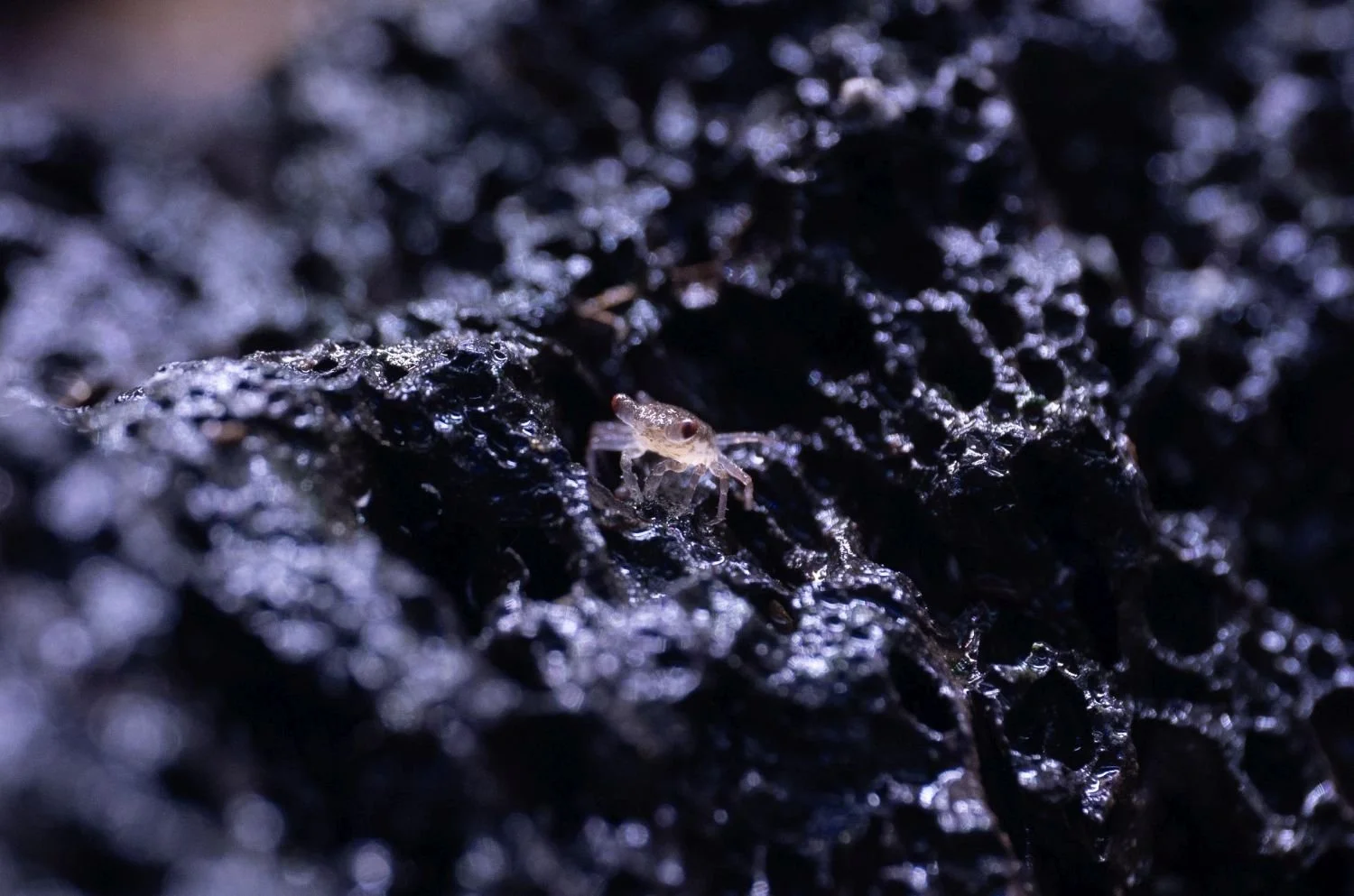
Picture: A captive-bred vampire crab safely foraging after ecdysis. Over sequential molts, damaged limbs regenerate into fully functional claws.
How Regeneration Works:
- The Autotomy Reflex: When a predator or rival male clamps onto a crab's claw, the crab can deliberately sever the limb at a pre-formed fracture plane located on the second leg segment (the basis-ischium). A specialized internal diaphragm instantly constricts, sealing off the blood vessel to prevent blood loss.
- Blastema (Limb Bud) Formation: Over the following weeks, specialized stem cells cluster at the stump, forming a small, gelatinous translucent sac known as a blastema or limb bud. Inside this protective envelope, a complete miniature claw is folded tightly like an origami crane.
- The Unfolding Molt: When the crab sheds its shell during its next molt, hydrostatic pressure pumps hemolymph into the folded bud. It bursts out as a fully formed, functional claw! Initially, this newly regenerated claw is roughly 60% to 70% of normal adult size. After one additional molt, it reaches full adult proportions.
- The One Thing That Cannot Regrow: While claws, walking legs, antennae, and mouthparts regenerate completely, vampire crabs cannot regenerate complex compound eyes. Ocular trauma is permanent and frequently fatal.
Dietary Minerals & Leaving Discarded Molts in Water
Ensuring your crabs never suffer from dysecdysis comes down to providing the essential chemical building blocks of shell formation:
1. Water Parameters for Calcification
Even though vampire crabs spend 80% to 90% of their lives on land, they rely on the aquatic section to absorb minerals through their gills. Maintain these parameters:
- General Hardness (GH): 6 to 12 dGH. Soft water (GH below 4) starves the crab of dissolved calcium and magnesium ions. If using reverse osmosis (RO) water, you must remineralize it with a trusted crustacean mineral buffer.
- Carbonate Hardness (KH): 3 to 8 dKH. Provides pH stability and prevents acidic crashes.
- pH: 7.5 to 8.0. Acidic water (pH below 7.0) slowly erodes crustacean shells, causing pitting, structural thinning, and molting failure.
2. The High-Calcium Nutrition Protocol
A crab cannot build a sturdy cuticle out of thin air. Feed a varied diet rich in bioavailable calcium, chitin, and carotenoids:
- Natural Chitin: Dried freshwater shrimp, krill, and gammarus. Consuming natural exoskeletons provides pre-formed acetylglucosamine—the exact polymer needed for shell construction.
- Bioavailable Calcium: Keep a clean piece of cuttlebone or boiled eggshell in the terrarium at all times. Crabs will actively scrape and graze on cuttlebone before molting.
- High-Protein Fuel: Rehydrated black soldier fly larvae, frozen bloodworms, and high-grade invertebrate sinking pellets fed 2–3 times weekly.
For complete dietary schedules, consult our full guide on what vampire crabs eat and how often to feed them.
Stop Crab Losses: The Complete Geosesarma Master Guide
Eliminate molting deaths, manage aggressive territory disputes, and construct self-sustaining bioactive paludariums. Get the official Indoor Ecosystem digital manual with complete nutritional formulas and emergency veterinary care protocols.
Explore the Guides & EbooksScientific Research on Decapod Ecdysis & Cuticle Biology
The physiological mechanisms governing crab molting are thoroughly documented in peer-reviewed carcinological and endocrinological literature:
1. Hormonal Regulation: Ecdysteroids & MIH (Skinner, 1985; Chang, 1993)
Crustacean molting is orchestrated by an endocrine axis between the Y-organ (which synthesizes 20-hydroxyecdysone) and the X-organ/sinus gland complex located inside the eyestalks (which secretes Molt-Inhibiting Hormone, or MIH). In healthy crabs, declining titers of MIH permit the Y-organ to surge ecdysteroids, initiating proecdysis. Chronic environmental stress—such as improper temperature, dry air, or water contaminants—disrupts this delicate hormonal feedback loop, leading to incomplete ecdysis or premature attempts to shed.
2. Calcium Resorption & Cuticular Calcification (Roer & Dillaman, 1984)
In their benchmark review published in the American Zoologist (24: 893–907), researchers analyzed how decapod crabs resorb massive amounts of calcium from the calcified endocuticle prior to exuviation. Because semi-terrestrial crabs like Geosesarma cannot easily extract infinite calcium from surrounding terrestrial air, they temporarily store mobilized calcium ions in hemolymph proteins and gastroliths. If water GH or dietary mineral reserves are depleted, the crab lacks the mineral density to properly harden the new shell post-ecdysis, resulting in soft-shell collapse.
3. Claw Dimorphism & Metabolic Costs of Regeneration (Juarez et al., 2024, Stanford University)
A 2024 biomechanical study on Geosesarma hagen led by Bryan H. Juarez and colleagues at Stanford University demonstrated that male claws carry extreme metabolic maintenance costs. Rebuilding an autotomized claw demands enormous protein and mineral redirection from the crab's hepatopancreas. Keepers must feed injured crabs high-protein foods to support blastema growth without depleting the crab's baseline immune defenses.
Molting Diagnostic & Troubleshooting Matrix
| Observed Behavior | Molting Stage | Status Assessment | Recommended Keeper Action |
|---|---|---|---|
| Faded colors, hiding in deep burrows | Proecdysis (Pre-Molt) | Normal & Healthy | Do not dig up; ensure 80%+ humidity and leave undisturbed |
| Submerged in water, rear shell split | Ecdysis (Active Molt) | Normal (15–45 min) | Turn off lights; do not touch or spray directly with water |
| Molting on land (G. notophorum / Purple Haze) | Terrestrial Ecdysis | Normal for these species | Maintain 90%+ air humidity; ensure moist moss cover |
| Soft, pale, motionless near shell | Metecdysis (Post-Molt) | Normal (Hardening) | Leave molt in tank/water; ensure peaceful hiding spots |
| Translucent papery shell in water, clear eyes | Cast Exuvia (Molt) | 100% Not Dead! | Leave in water for crabs, shrimp & snails to eat for minerals |
| Stuck halfway out for >12 hours | Dysecdysis (Failed Molt) | Life-Threatening | Max humidity to 100%; ensure shallow water access; do not pull |
| Heavy, solid body, opaque eyes, foul odor | Deceased Crab | Fatal Outcome | Remove carefully; check GH/KH and tank aggression levels |
Molting is a natural, awe-inspiring process that showcases the incredible resilience of Geosesarma crabs. By providing high-calcium nutrition, maintaining stable GH 6–12 dGH water, understanding whether your species molts in water or on land, leaving cast molts in the tank for a mineral boost, and resisting the urge to intervene with tweezers, you will help your vampire crabs navigate every molt with ease!
If you're diagnosing health issues across your colony, don't miss our comprehensive guide on the most common reasons vampire crabs die in captivity.