

Growing a lush, vibrant green carpet in your aquarium is a milestone that almost every aquascaper strives to achieve. There is nothing quite like looking into a planted tank and seeing a seamless mat of bright green foreground foliage covering the substrate.
But establishing an aquarium carpet is not an easy task. It takes time, patience, balanced lighting, and good substrate chemistry. What many hobbyists do not realise until it is far too late is that certain animals can completely destroy this process overnight. If you stock the wrong fish, shrimp, or snails after planting, you are setting yourself up for hours of frustration, dead plants, and wasted money.
Best Fish for Carpeted Aquariums: What to Stock (and 6 Animals to Avoid)
Carpet & Livestock FAQs
Can you keep Corydoras in a carpeted aquarium?
Larger Corydoras species (like Bronze, Peppered, or Sterbai) should be avoided because their bottom-foraging rooting behavior destroys delicate young plant roots. However, Pygmy Corydoras (Corydoras pygmaeus) are carpet-safe because they hover in midwater and do not violently sift through aqua soil.
Jump to: Why Standard Corydoras Fail →Are Amano shrimp bad for aquarium carpets?
During the first 4 to 8 weeks of establishing a new carpet, yes. Amano shrimp aggressively sift through aqua soil looking for food and frequently uproot fresh, unanchored plant plugs. Once a carpet is fully established and root-bound, Amano shrimp are safe and beneficial.
Jump to: The Amano Shrimp Paradox →Do Kuhli Loaches ruin carpeting plants?
Yes. Kuhli loaches are instinctive burrowers that dive straight under the substrate to find food and hide. Their tunneling behavior tears through the root networks of carpeting plants like Monte Carlo and Hemianthus callitrichoides.
Jump to: Kuhli Loach Burrowing Risks →What are the best algae eaters for a carpeted tank?
Otocinclus catfish and dwarf freshwater shrimp (such as Neocaridina Cherry shrimp) are the best choices. They are remarkably gentle, eat diatom algae and biofilm directly from leaf surfaces, and exert zero uprooting pressure on the substrate.
Jump to: Otocinclus: The Ultimate Grazer →Can Malaysian Trumpet Snails live in a planted carpet aquarium?
No. Malaysian Trumpet Snails spend 99% of their daylight hours plowing beneath the substrate. This subterranean movement continuously dislodges shallow-rooted carpeting plants, causing them to float to the surface.
Jump to: Malaysian Trumpet Snails Danger →Why Young Carpets Get Uprooted So Easily
Before jumping into specific animal profiles, it is important to understand the biological reality of how carpeting plants grow. Whether you are working with Monte Carlo without CO2, Dwarf Hairgrass, Marsilea crenata, or Glossostigma, their initial root systems are paper-thin.
When you plant micro-cuttings into granular aqua soil, it takes anywhere from 4 to 8 weeks for those runners to intertwine beneath the surface. Until this root network locks together like a natural mat, each individual clump is held down by little more than gravity and friction.
Any aquatic animal that burrows into the dirt, bulldozes through bottom sediment, or picks energetically at individual soil pellets will dislodge these clumps. Once a small portion lifts from the substrate, water current gets underneath it, and the entire patch floats to the surface—costing you weeks of progress.
Aquarium Animals You Must Avoid With Carpets
If you want a thick, stable, and seamless carpet, you should avoid stocking the following species—especially during the establishment phase:
1. Amano Shrimp (Caridina multidentata) — The Early Stage Bulldozer

Photo: An adult Amano Shrimp (Caridina multidentata). Source: Richard Bartz / Wikimedia Commons, licensed under CC BY-SA 2.5.
Amano shrimp are widely regarded as the holy grail of cleanup crews in the aquascaping world. They eat green hair algae, tackle diatoms, and are relentless scavengers. But they are also one of the worst offenders for newly planted aquarium carpets.
Amano shrimp are notorious for their digging habits. They are constantly rearranging aqua soil granules, turning over pellets, and bulldozing through loose planting holes in search of micro-debris and algae. What makes the situation worse is that aquascapers usually add a small army of them (10 to 20 shrimp) right after cycling to keep diatoms at bay.
This constant physical disturbance almost always results in delicate Monte Carlo or Dwarf Hairgrass plugs being pulled clean out of the substrate before their roots can take hold. Once they float to the top, replanting them repeatedly disturbs the substrate even further.
2. Standard & Large Corydoras Catfish

Photo: Sterbai Corydoras (Corydoras sterbai). Source: Nicklas Iversen / akvaportalen.no / Wikimedia Commons, licensed under CC BY-SA 4.0.
Corydoras are absolute hobby favourites: they are peaceful, endlessly charming, and active bottom-dwellers. However, larger species—such as Bronze Corys (Corydoras aeneus), Peppered Corys (Corydoras paleatus), and Sterbai Corys (Corydoras sterbai)—should be strictly avoided in carpeted setups.
These fish are biologically engineered to forage by driving their sensitive barbels deep into loose substrate. They snuffle through the top layer of dirt like miniature tractors, violently blowing sand and dislodging granular soil in search of worms and sinking food. In a carpeted tank, this behavior systematically rips up delicate runner roots and creates craters in your pristine green floor.
If you have your heart set on Corydoras, dwarf hairgrass is slightly more resilient than delicate stem carpets like Monte Carlo once it has formed a thick turf. But standard Corydoras will always be a gamble. Fortunately, there is a miniature exception that works wonders, which we cover below.
3. Kuhli Loaches (Pangio semicincta)

Photo: Kuhli Loach (Pangio kuhlii / semicincta). Source: Neil916 / Wikimedia Commons, licensed under CC BY 3.0.
Kuhli loaches are captivating, eel-like oddball fish that bring incredible personality to a community tank. But they are absolute carpet-murdering machines.
In nature, Kuhli loaches spend their lives burrowing under leaf litter, soft silt, and sand. In an aquarium, they exhibit this exact same instinct: they love nothing more than tunneling headfirst into the substrate, disappearing beneath plant roots, and wriggling out a few inches away. If you have ever watched a group of Kuhli loaches actively hunting for food at night, you know just how violent their substrate churning can be.
A school of Kuhli loaches will undermine the entire underside of your carpet, severing subterranean roots from beneath. The only time I have ever seen them cohabit with a carpet is in deeply rooted, mature dwarf hairgrass setups that had been growing undisturbed for 6 to 12 months.
4. Plecos & Bristlenose Catfish (Ancistrus species)

Photo: Bristlenose Catfish (Ancistrus sp.). Source: Wikimedia Commons, licensed under CC BY-SA 3.0.
Bristlenose Plecos (Ancistrus sp.) are commonly purchased as algae-eating workhorses. While they do a stellar job cleaning driftwood and glass, they are terribly suited for delicate carpeted aquariums.
Plecos are bulky, heavy-bodied fish with powerful caudal fins. When they forage along the bottom, their rasping mouthparts scrape forcibly across surfaces, easily ripping delicate foreground stems apart. Furthermore, when startled, Plecos execute powerful bursts of speed that kick up massive clouds of aqua soil, blasting unrooted carpet plants straight out of the ground.
If you want a carpet-safe cleaner that performs the algae-eating job of a Bristlenose catfish ten times better without damaging a single leaf, get a group of Otocinclus catfish instead.
5. Malaysian Trumpet Snails (Melanoides tuberculata)

Photo: Malaysian Trumpet Snail (Melanoides tuberculata). Source: H. Zell / Wikimedia Commons, licensed under CC BY-SA 3.0.
Malaysian Trumpet Snails (MTS) have a cone-shaped shell and are notorious for their subterranean habits. They spend 99% of their time burrowing beneath the substrate during the day, only emerging at night when the aquarium lights turn off.
While this burrowing behavior is praised in traditional planted tanks for aerating deep dirt beds and preventing anaerobic pockets, it is disastrous for carpeting aquascapes. Their constant churning destabilises the top 1–2 inches of soil, preventing delicate micro-roots from forming an anchor. If you accidentally introduce MTS through unsterilized plants, they can multiply into hundreds and systematically cause your carpet to float.
Worse still, MTS are virtually impossible to eradicate once established. Assassin snails (Clea helena) can help suppress their numbers, but rarely eliminate them completely.
6. Mystery Snails (Pomacea diffusa) & Large Nerites

Photo: Golden Mystery Snail (Pomacea diffusa / bridgesii). Source: MdE / Wikimedia Commons, licensed under CC BY-SA 3.0 DE.
Mystery snails are beloved for their vibrant shell morphs, curious antennae, and quirky behaviors. However, they are simply too big and heavy for young, fragile plant carpets.
An adult Mystery snail can reach the size of a golf ball. As they cruise over delicate Monte Carlo or Baby Tears, their sheer physical bulk acts like a steamroller. They press down on unanchored stem nodes, dislodging the tiny root fibers from loose soil pellets and sending entire clumps floating to the surface. Nerite snails are a close second—while smaller, their stiff shells and stubborn bulldozing can easily unseat unrooted foreground plantings.
If you need snails to keep your glass and hardscape clean during the early stages, stick to tiny species like Ramshorn snails or Bladder snails, which do not carry enough weight to dislodge plants.
Take Your Planted Habitat Knowledge Further
Looking to master low-maintenance aquascapes, substrate balancing, bioactive cleanup crews, and crustacean husbandry? The Indoor Ecosystem digital guide collection covers everything from naturalistic water chemistry and lighting balance to long-term planted tank success.
Explore the Guides & EbooksCarpet-Friendly Livestock: What You Should Stock
Now that we have covered the troublemakers, what animals can you safely add to a carpeted tank that will keep the ecosystem pristine without ruining your hard work?
1. Dwarf Shrimp (Neocaridina & Caridina)

Photo: Red Cherry Shrimp (Neocaridina davidi). Source: Wikimedia Commons, licensed under CC BY-SA 3.0.
Freshwater dwarf shrimp—such as Cherry Shrimp (Neocaridina davidi) and Crystal Red Shrimp (Caridina cantonensis)—are by far the single best creatures you can introduce to a carpeted tank.
Unlike bulky Amano shrimp, dwarf shrimp are featherlight and extraordinarily gentle. They walk delicately across the carpet canopy without depressing a single stem. They use their micro-claws to pick off decaying plant matter, algae spores, and trapped detritus that falls between the dense mat of leaves. During the early days when young plant cuttings experience slight transition melt, Cherry shrimp clean away the decomposing foliage before fungus or black beard algae can take hold.
If you also keep semi-terrestrial setups, read our guide on shrimp compatibility in paludariums to see why dwarf shrimp are nature's ultimate maintenance crew.
2. Pygmy Corydoras (Corydoras pygmaeus) — The Safe Cory
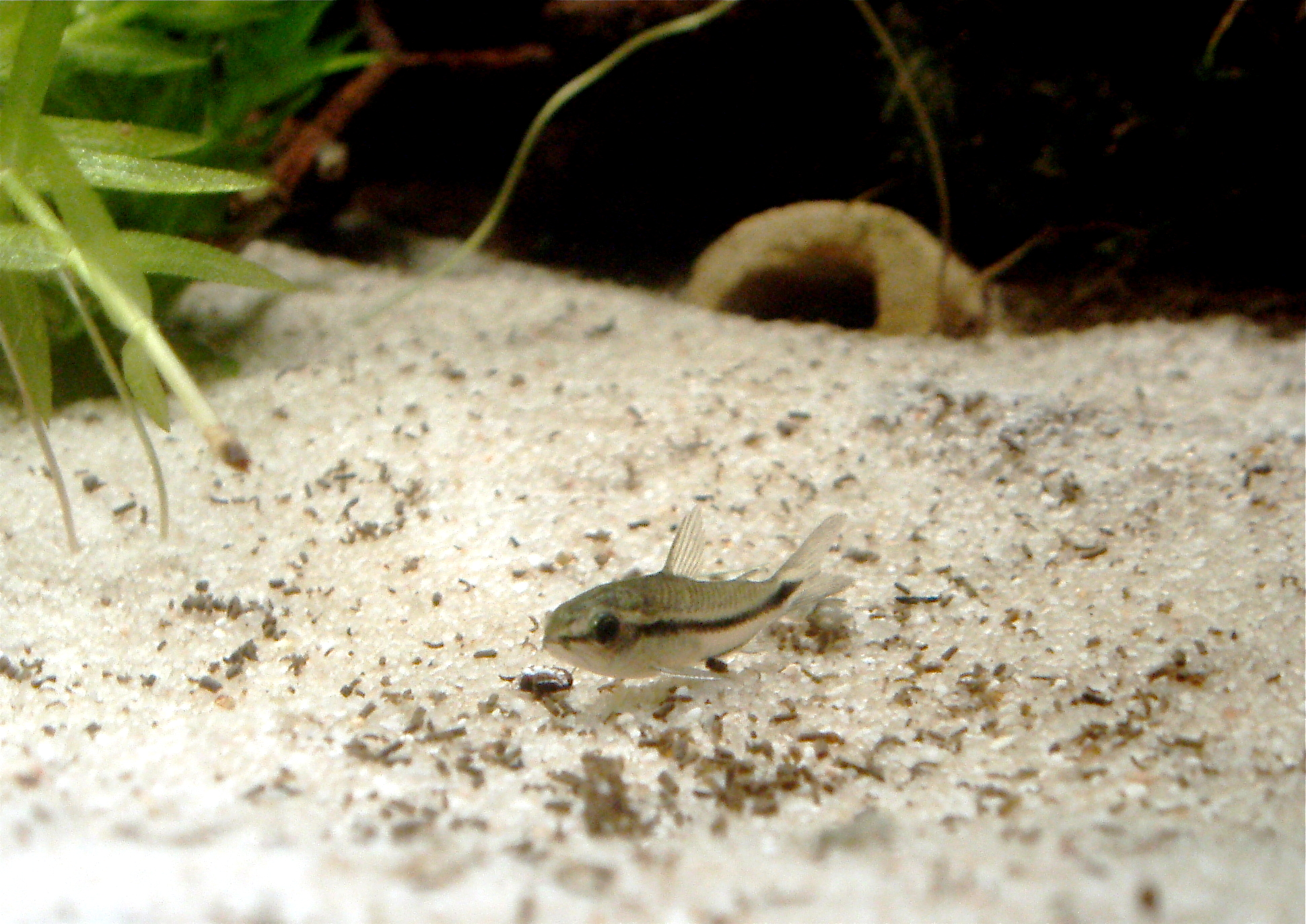
Photo: Pygmy Corydoras (Corydoras pygmaeus). Source: Wikimedia Commons, licensed under CC BY-SA 3.0.
If you love Corydoras catfish but refuse to sacrifice your aquarium carpet, Pygmy Corydoras are your answer. They are the only Cory species you can safely keep with a delicate carpet from day one.
Unlike standard bottom-dwelling Corydoras, Pygmy Corys are midwater schooling fish. They spend roughly 70% of their time hovering mid-column in small schools, occasionally resting gently on broad leaves or perched harmlessly atop the carpet. They do not possess the mass or force required to sift violently through soil. I have kept these little legends in numerous carpeted tanks over the years and have never experienced a single uprooted plant.
3. Nano Schooling Fish & Upper Column Dwellers

Photo: Chili Rasbora (Boraras brigittae). Source: JoKrimmel / Wikimedia Commons, licensed under CC BY-SA 4.0.
Nano fish that inhabit the middle and upper levels of the water column are ideal companions for a carpeted aquascape. Because they never interact with the substrate floor, your carpet can grow completely uninterrupted while they provide stunning color contrast against the green foreground.
Excellent nano schooling species include:
- Chili Rasboras (Boraras brigittae): Tiny, vibrant red nano fish that provide an incredible visual contrast against green Monte Carlo.
- Ember Tetras (Hyphessobrycon amandae): Alert, fiery orange midwater dwellers that swim safely above the bottom.
- Celestial Pearl Danios (Danio margaritatus): Gorgeous patterning; learn more in our complete CPD care and breeding guide.
- Clown Killifish (Epiplatys annulatus): Spectacular nano surface hunters that spend 99% of their time at the top water tension (just ensure your tank has a secure lid!).
4. Otocinclus Catfish (Otocinclus sp.)

Photo: Otocinclus Catfish (Otocinclus sp.). Source: Evan Baldonado / AquariumKids.org / Wikimedia Commons, licensed under CC BY-SA 4.0.
If you need an algae eater that clears brown diatoms and soft green algae off your carpet without damaging foliage, Otocinclus are unmatched.
While Plecos are rough and destructive, Otos are small, lightweight, and gentle. They utilize a soft suckermouth to graze algae from individual leaves without puncturing the leaf structure or pulling on the roots. Keep them in groups of 6 or more in mature tanks with adequate biofilm, and your carpet will remain sparkling clean.
Carpet-Safe Companions in Action
Watch how peaceful and gentle carpet-safe species are when cohabiting. In this video, you can see Cherry Shrimp and Pygmy Corydoras living alongside delicate plantings without disturbing a single grain of substrate:
Aquarium Animal Carpet Compatibility Matrix
| Species name | Behavior profile | Uprooting danger | Carpet safety rating |
|---|---|---|---|
| Neocaridina Shrimp (Cherry Shrimp) | Gentle surface picker | None (0%) | Ideal (10/10) |
| Otocinclus Catfish | Soft suckermouth grazer | None (0%) | Ideal (10/10) |
| Pygmy Corydoras (C. pygmaeus) | Midwater hoverer / leaf percher | Extremely Low | Excellent (9.5/10) |
| Nano Schoolers (Rasboras, Tetras) | Mid & upper column swimmer | None | Excellent (10/10) |
| Amano Shrimp (C. multidentata) | Aggressive soil excavator | High (Early stage) | Wait 8 Weeks (5/10 Early) |
| Bristlenose Pleco (Ancistrus) | Heavy rasping grazer | High | Avoid (3/10) |
| Standard Corydoras (Bronze, Sterbai) | Violent barbel substrate sifter | Very High | Avoid (2/10) |
| Mystery / Apple Snails | Heavyweight bulldozer | High | Avoid (2/10) |
| Kuhli Loaches (Pangio semicincta) | Subterranean root burrower | Extreme | Incompatible (1/10) |
| Malaysian Trumpet Snails | Substrate tunneling digger | Extreme | Incompatible (0/10) |
The 3 Golden Rules for a Perfect Aquarium Carpet
To summarize everything we have learned from years of aquascaping and growing dense carpets without headaches, remember these three simple rules:
- The 8-Week Livestock Quarantine: Do not add bottom-dwelling cleanup crews (especially Amano shrimp or snails) during the first 6 to 8 weeks after flooding. Allow your plants to form an unbroken, interlocked root matrix before introducing larger scavengers.
- Choose Midwater Nano Fish First: If you want movement in your tank early on, stock tiny middle-and-upper dwellers like Chili Rasboras, Ember Tetras, or CPDs. They produce mild bioload to feed beneficial nitrifying bacteria without touching the floor.
- Rely on Neocaridina & Otos for Cleaning: When diatom or hair algae appears, avoid heavy bottom cleaners. A colony of 15–20 Cherry Shrimp and 6 Otocinclus will keep every millimeter of your carpet spotless without uprooting a single stem.
Growing an aquarium carpet is an incredibly rewarding milestone in the hobby. By keeping the destructive burrowers and bulldozers out of your tank, you will save yourself countless replanting headaches and enjoy a stunning, flawless green lawn for years to come!