
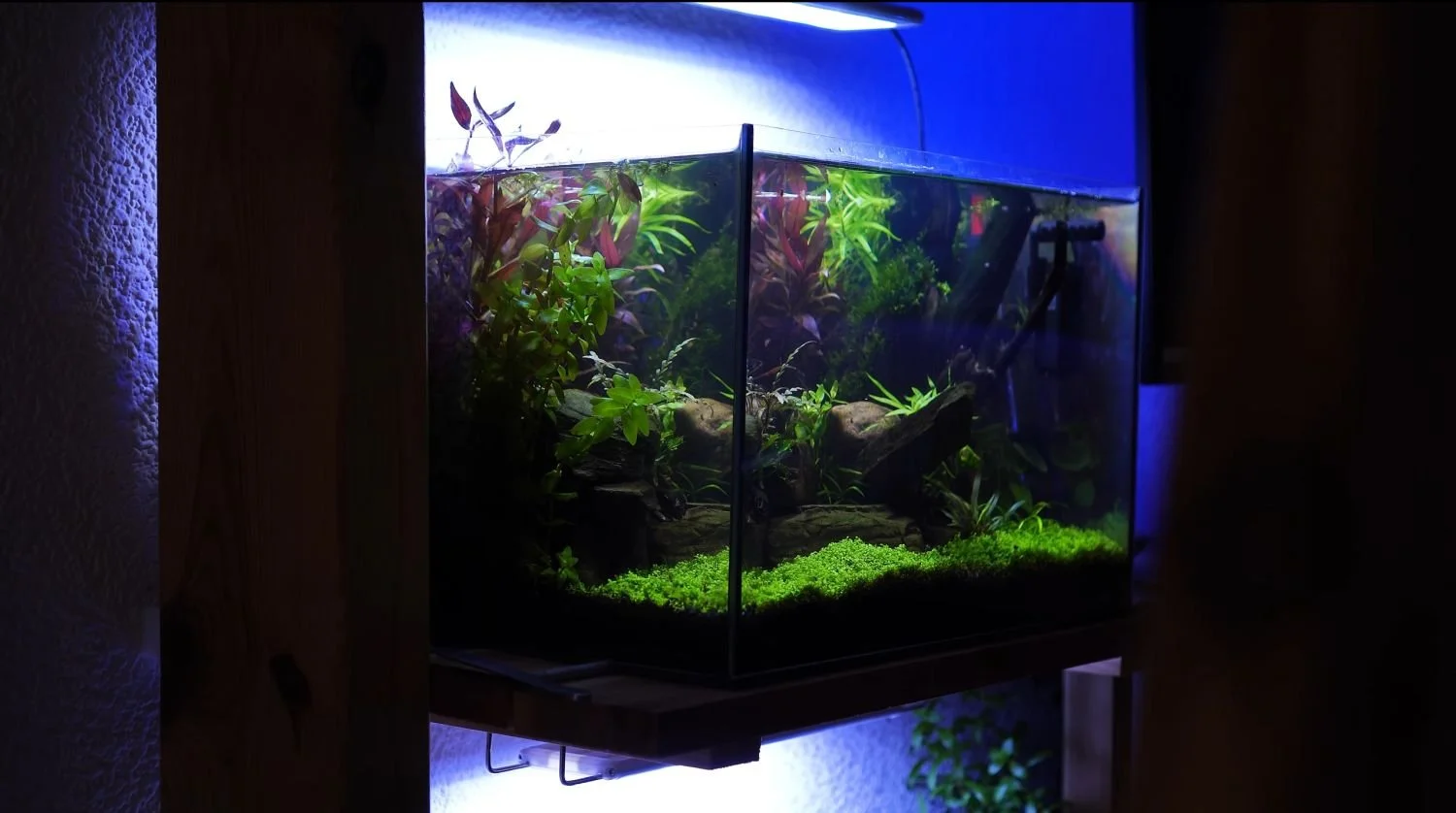
Monte Carlo (Micranthemum tweediei) is one of the most popular carpeting plants in the aquascaping hobby, but it also has quite a few myths surrounding how best to grow it. For a long time, it was gatekept by the high-tech, CO2-using section of the hobby.
However, as more and more people experiment with it, they have found it can grow perfectly fine without any CO2 at all. Though there are some specific things you need to do to make it work. In this guide, I'll show you how you can grow a Monte Carlo carpet without CO2.
Can You Grow Monte Carlo Without CO2?
Monte Carlo & No CO2 FAQs
Can you grow Monte Carlo without CO2?
Yes, absolutely! Monte Carlo (Micranthemum tweediei) can be grown into a thick, lush carpet without any pressurized CO2 injection, provided you use nutrient-rich aqua soil, moderate lighting, and plant it closely together.
Jump to: Tank Setup & Budget →Is the Dry Start or Wet Start method better for Monte Carlo without CO2?
Both methods work, but the Dry Start Method is superior for non-CO2 setups. It allows Monte Carlo to absorb unlimited atmospheric CO2 and establish deep root networks in the soil for 6 to 8 weeks before flooding, preventing the plants from floating.
Jump to: Planting Methods Compared →How long does it take Monte Carlo to carpet without CO2?
Without CO2, a Monte Carlo carpet typically takes between 6 to 10 weeks to fully establish and cover the substrate, compared to 4 to 6 weeks with high-tech CO2 injection.
Jump to: Growth Timeline Matrix →Do you need liquid fertilizers for Monte Carlo without CO2?
If you use a quality aqua soil and stock gentle livestock like dwarf shrimp and snails, you generally do not need to add liquid fertilizers for the first 12 to 18 months. The soil and biological waste provide all necessary nutrients.
Jump to: Fertilizing Strategy →Why is my Monte Carlo carpet floating to the surface?
Monte Carlo floats when it is not trimmed regularly. Once the carpet exceeds 1.5 inches (3.5 cm) in thickness, light cannot reach the bottom layer of stems, causing the subterranean roots to die and rot, which unanchors the entire carpet.
Jump to: Trimming Rules →How to Grow a Monte Carlo Carpet Without CO2 Video
I put this video guide together because so many people believe the myth that Monte Carlo won't grow without CO2. Watch the full build process, equipment specs, and months of growth progression below:
1. Tank Setup & Budget Cost
You sure can grow Monte Carlo without CO2, and I'm going to show you exactly how in a few simple steps. It's also not that expensive either. For starters, you don't need to spend a lot of money to get a good result. Here is my budget setup:
- Tank: $20 (roughly 25 litres / 6.6 gallons, dimensions 40 x 25 x 25 cm).
- Light: $10, a basic 10W to 12W LED aquarium lamp (Kruger Meier Larino S-Line 30–40 cm) that supports plant growth.
- Aqua Soil: Yokuchi Jiban Soil (4L). Any good-quality aqua soil works.
- Filter: A SunSun 120L (450 l/h HJ-611B) internal filter or Hang-On-Back (HOB). While not 100% required, a filter keeps the water clear and circulating.
This is really all you need to grow a Monte Carlo carpet without any CO2!
2. Substrate & Planting Depth
The substrate is the single most important factor when you are not injecting CO2. Because Monte Carlo cannot rely on dissolved carbon dioxide injected directly into the water column, it relies heavily on absorbing micro- and macro-nutrients through its root system.
I used Yokuchi Jiban Soil, which is a nutrient-dense mineral aqua soil. Lay the soil down at about 1 inch (2.5 cm) thick across the front, and slope it slightly higher toward the back. This provides enough depth for delicate roots to anchor firmly without suffocating.

Picture: Day 1 — Setting up a 5-gallon low-tech planted aquarium with Monte Carlo plugs planted closely into nutrient-rich aqua soil.
3. Lighting & Photoperiod Rules
Lighting is really important to keeping your Monte Carlo healthy and promoting its compact, horizontal spreading growth. You don't need anything fancy or expensive, just a basic light that can grow plants.
However, you will need to make sure your light is powerful enough to reach the bottom of the tank. The deeper your tank, the more powerful your light should be. For shallow or small tanks like the one I'm using (25 cm deep), just about any standard $10 to $20 clip-on LED light is powerful enough.
The Light Schedule:
- Weeks 1 to 4: Run the light for 10 hours a day. This gives the unrooted tissue-culture clumps plenty of photosynthetic energy to jumpstart root production.
- Week 4 Onward: Wind the timer back to 8 hours a day. In a non-CO2 setup, leaving high lighting on for 10+ hours indefinitely will cause diatom or hair algae outbreaks. Eight hours is the sweet spot.
If money isn't something you're too worried about, I highly recommend Skylight Entriq Lights. They aren't cheap, but boy are they good!
Video: Skylight Entriq Lights Review & Setup
In this video, I walk through unboxing, mounting, and configuring the app for the Skylight Entriq range for planted aquariums:
4. Planting Monte Carlo: Wet Start vs. Dry Start
There are two main ways to establish a Monte Carlo carpet: the Wet Start Method and the Dry Start Method. Both have their advantages, but they require slightly different handling:
The Wet Start Method
For the wet start method, you plant the tank and flood it with water on Day 1:
- Break up the Monte Carlo: Take your pots or tissue cultures and break them into smaller clumps. For my 25L tank, I used four small 6-centimeter containers of Monte Carlo.
- Plant Deeply and Close Together: Using aquascaping tweezers, plant the clumps deeply into the aqua soil and space them closely together. Leaving only the tips of the leaves exposed prevents them from floating.
- Fill the Tank Extremely Slowly: Place plastic bubble wrap, a plate, or a plastic bag over the substrate and pour water over it very, very slowly. If you rush, the water current will uproot the light plugs instantly.
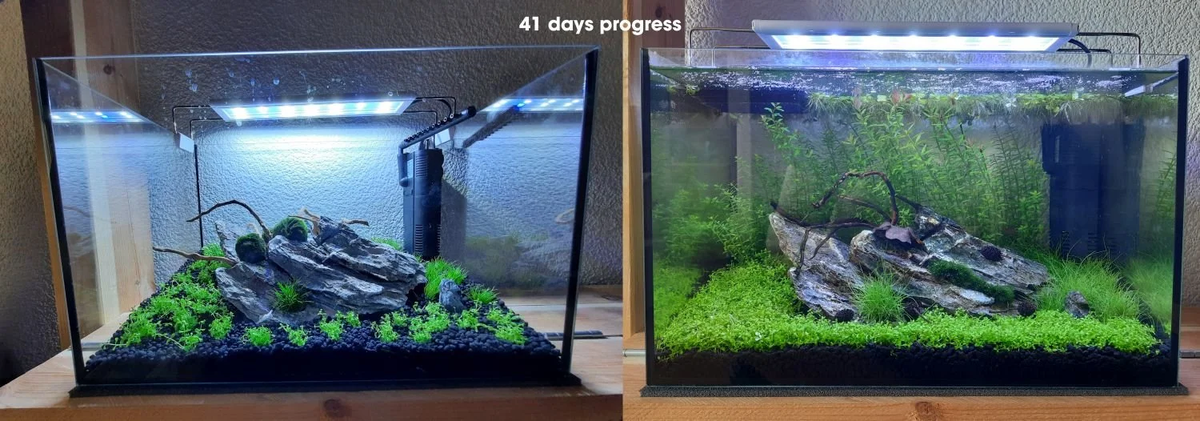
Picture: Real progression — Before (left) and after 41 days (right) showing how aggressively Monte Carlo spreads across the substrate without any CO2 injection.
With the wet start method, you usually don't experience as much transition meltback, but the plants have a tendency to float up until their roots grab the soil.
The Dry Start Method (Recommended for No CO2)
Lately, I've been leaning toward the Dry Start Method because it's less work, eliminates floating plants entirely, and lets the plants exploit unlimited atmospheric CO2 from the air:
- Break into Tiny Bits: Break the Monte Carlo into even smaller pieces—the smaller the better. Lay them directly across the surface of your damp aqua soil, covering as much surface area as possible.
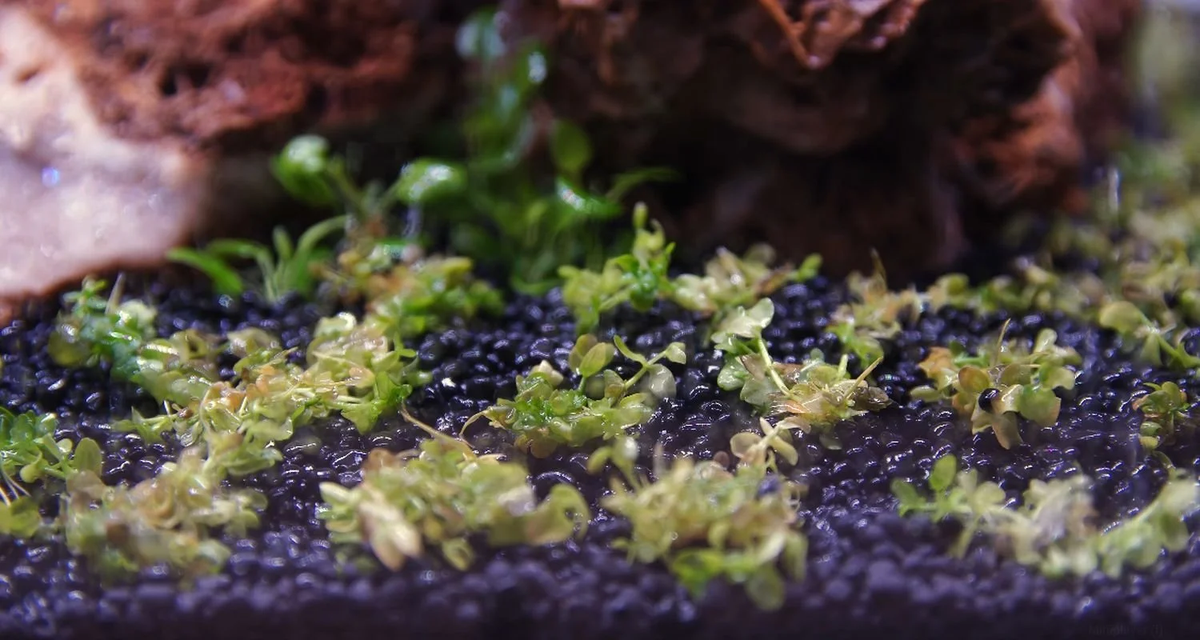
Picture: Dry starting Monte Carlo — breaking down the plant into tiny pieces and spreading them evenly across the damp aqua soil surface.
- Light Mist: When you have covered the entire surface area, spray it down lightly with a spray bottle so that the moisture settles the Monte Carlo into the granules. Don't spray too much—you just want moist soil, not standing puddles of water.
- Add Springtails (Optional but Highly Recommended): Add a small starter culture of springtails to the tank. These little critters will take care of any mold and eat any decaying foliage during the transition.

Picture: Add springtails to a Monte Carlo dry start to clean up decaying leaves, stop mold outbreaks, and boost success!
- Seal the Tank: Cover the tank completely with a glass lid or clear cling wrap to lock in 95%+ humidity.
- Wait 6 to 8 Weeks: Mist the tank lightly with water once or twice a week. In 6 to 8 weeks, the plants will establish deep roots and form a dense green lawn. Once firmly rooted, slowly fill the tank with water!
You may see a little meltback after a couple of weeks post-flood as the leaves convert to their submerged form, but your carpet will be 100% anchored and will never float up.
Video: Shallow Aquarium Iwagumi Aquascape Tutorial
In this video, I set up a custom super-shallow Iwagumi layout using Maple Stone, Contra Soil, and the Dry Start Method with Monte Carlo:
Note: While this specific display tank uses pressurized CO2 post-flood due to high-demand companion stem plants, the Dry Start Method itself does not require CO2 at all. Without demanding stem plants, this exact layout, planting density, and dry-start technique works 100% fine in a low-tech, non-CO2 setup.
5. Caring for Your Carpet: Trimming & Algae
Even without CO2, your Monte Carlo will grow vigorously once established. Here is how to maintain it for the long haul:
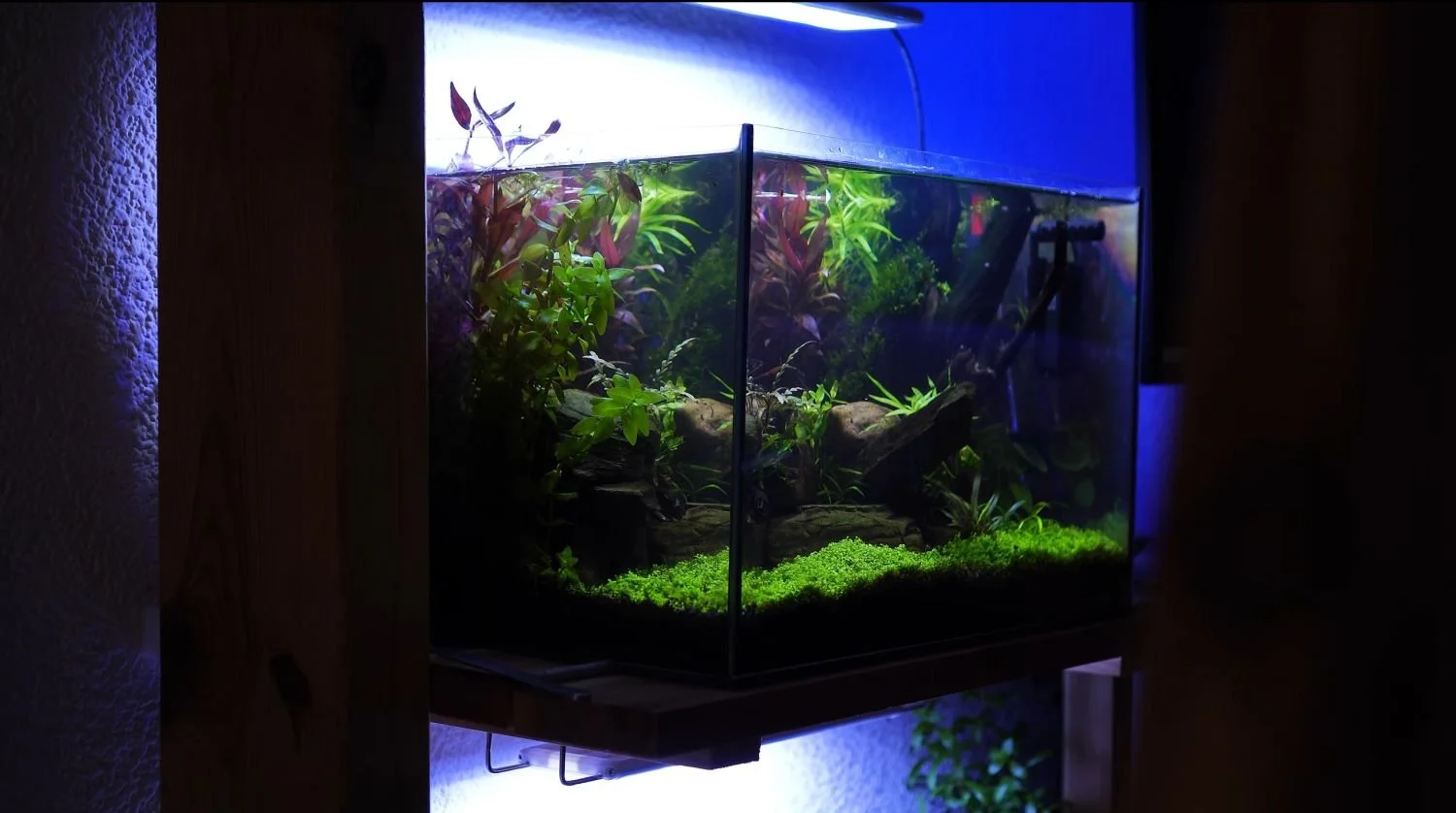
Picture: Another low-tech tank with a Monte Carlo carpet at 7 to 8 weeks. The runners have fully closed in and locked into the aqua soil.
1. The Trimming Rule (Preventing Floating Carpets)
Once the carpet reaches about 1.5 inches (3.5 cm) in height, trim it down using curved aquascaping scissors. If you don't trim it regularly, the upper canopy shades out the bottom layers. The leaves and roots underneath will die off from lack of light, causing the entire carpet to detach from the substrate and float to the surface—which almost always means a complete tank restart!
After a heavy trim, the carpet might look a little scruffy for a few days, but don't worry: it will bounce back thicker and greener than before.
Video: Monte Carlo Carpet Melting or Dying? Here's the Solution!
If your carpet is experiencing brown spots, melting foliage, or root detachment, this video explains the exact biological fix:
2. Algae Control
In the early stages of your tank, it is completely normal to experience some diatom (brown algae) issues. I had a few algae issues in the first few weeks, but this subsided naturally as the tank matured. If algae becomes persistent, slightly reduce your light duration (down to 7 or 8 hours) and introduce gentle cleanup helpers.
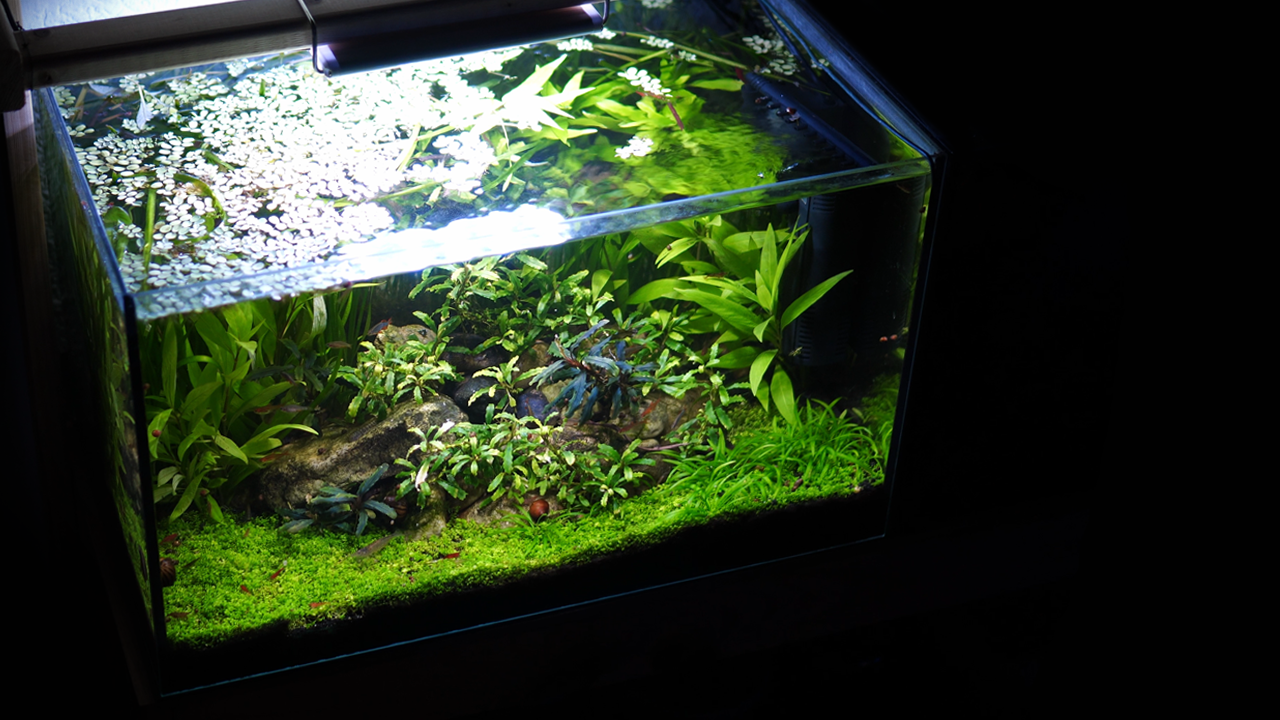
Picture: "The Buce Grove" — a fully established 45L planted aquarium featuring a thick, seamless Monte Carlo carpet grown completely without CO2 alongside bucephalandra.
6. Fertilizing Your No CO2 Monte Carlo Carpet
Many aquascapers overcomplicate fertilizers. If you used a fairly decent aqua soil and have fish, dwarf shrimp, or snails in your tank, you probably won't have to fertilize your tank for the first 12 to 18 months. So far, that has been my consistent experience across multiple low-tech tanks.
However, if you have a lot of other hungry stem plants in your tank competing for nutrients, you can start dosing a lean micro and macro liquid fertilizer after about 6 months to keep things vibrant. Generally, small doses of Nitrate (NO3) and Phosphate (PO4) are more than enough.
Animals to Avoid With Your New Carpet!
Once your carpet is growing, choosing the wrong livestock will completely ruin weeks of hard work. Digging fish, heavy snails, and early cleanup crews will tear unanchored Monte Carlo straight out of the substrate.
Before stocking your aquarium, make sure you read our dedicated companion guide: Best Fish for Carpeted Aquariums (And 6 Species to Avoid). It breaks down why Corydoras, Kuhli Loaches, and early Amano shrimp destroy carpets, and what safe nano fish and shrimp you should keep instead!
Take Your Planted Habitat Knowledge Further
Looking to master low-maintenance aquascapes, substrate balancing, bioactive cleanup crews, and crustacean husbandry? The Indoor Ecosystem digital guide collection covers everything from naturalistic water chemistry and lighting balance to long-term planted tank success.
Explore the Guides & EbooksMonte Carlo Low-Tech Specifications Matrix
| Parameter | Low-Tech Requirement | High-Tech (With CO2) Comparison | Keeper Priority |
|---|---|---|---|
| CO2 Injection | None (Atmospheric Exchange) | 15–30 ppm Pressurized | Not Required (Myth debunked) |
| Substrate | Aqua Soil (Jiban, Tropica, ADA) | Aqua Soil or Inert with Tabs | Critical (Primary nutrient source) |
| Substrate Depth | 1 inch front, sloping back | 1–2 inches | High (Prevents floating) |
| Lighting Power | 10–12W LED (Moderate) | High Output (PAR 60–100+) | High (Must reach bottom) |
| Photoperiod | 10 hrs early, 8 hrs established | 6 to 8 hrs with high CO2 | Moderate (Prevents algae) |
| Water Temperature | 20–26°C (68–78°F) | 20–26°C (68–78°F) | Moderate |
| Trimming Frequency | Every 4 to 6 Weeks | Every 2 to 3 Weeks | Critical (Stops carpet floating) |
| Time to Full Carpet | 6 to 10 Weeks | 4 to 6 Weeks | Patience Required |
Conclusion: No CO2? No Problem!
Many people believe that CO2 is necessary to grow a Monte Carlo carpet, but that's simply not true. While adding CO2 can speed up growth and make your plants look a bit fuller, it is not essential for success. My tanks have no CO2, and I've seen fantastic, lush carpets thrive for years.
By using a good aqua soil, giving it decent lighting, and keeping up with trimmings, you can achieve a stunning green foreground on a budget. If you have any questions, feel free to ask on my YouTube channel or check out our guide on shrimp tank mates to complete your low-tech planted ecosystem!