
PEA PUFFER CARE GUIDE: COMPLETE DWARF PUFFER FISH CARE
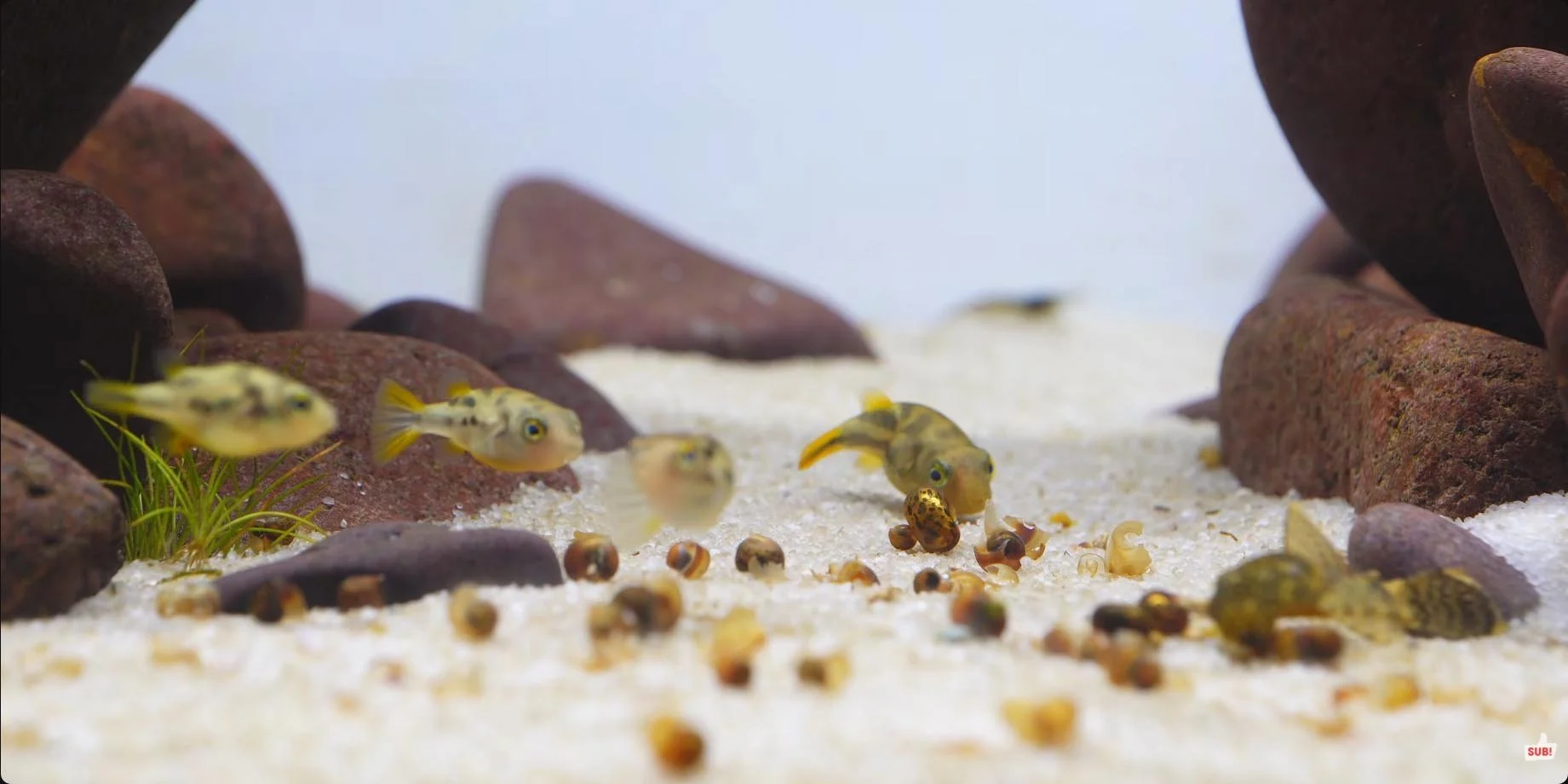
Pea Puffer (Carinotetraodon travancoricus)
The Pea Puffer (Carinotetraodon travancoricus) is the world's smallest pufferfish, reaching approximately 2.5 cm (1 inch). Native to the rivers, wetlands, and floodplains of Kerala and southern Karnataka in India, they are intelligent, active, and highly social fish that thrive in groups. Pea Puffers are listed as Vulnerable by the IUCN due to habitat loss and historical collection pressure. Whenever possible, choose captive-bred specimens.
Natural Habitat
In the wild, Pea Puffers inhabit slow-moving, heavily vegetated waters with leaf litter, roots, and dense marginal cover. Water conditions recorded from their native range include:
Temperature: 25-28°C (77-82°F)
pH: 7.3-8.0
Moderate hardness
They feed primarily on aquatic insects, small crustaceans, worms, and other tiny invertebrates.
Aquarium Setup
Pea Puffers thrive in densely planted aquariums with:
Heavy planting
Driftwood and rockwork
Floating plants for shade
Broken sightlines and visual barriers
Fine sand substrate
Water flow should be gentle to moderate. Strong currents should be avoided.
A secure lid is super important, as startled puffers may jump. While they don’t like they they would be good jumpers, they freak out quite often and will jump out of the corners of your tank. If you can’t use a lid lower the water level an inch or two.
Substrate
Fine sand is strongly recommended. Pea Puffers may dive into the substrate when frightened, and coarse gravel can cause injury. If using aquasoil or plant substrates, cap them with at least 1.5 cm of fine sand. Since aquasoil is quite soft this isn’t required but a suggestion.
Social Behaviour
Unlike most pufferfish, Pea Puffers are naturally social and should be kept in groups.
Minimum recommended group size:
6 Pea Puffers
Larger groups distribute aggression more effectively and allow natural social hierarchies to form. Solitary fish often become withdrawn, stressed, or excessively aggressive. Start with 6 and if you have the space add a few more. I’ve found 8 to be a good number for most people starting out.
Male to Female Ratio
Males are more territorial than females.
Recommended ratio:
1 male per 2 or more females
Example:
2 males and 4 females in a group of 6
This might not be possible so if you can’t get the perfect ratio don’t stress to much. Tank design will reduce fighting and aggression.
Tank Size
Recommended stocking.
30 L Shallow (8 US gal): 6 puffers (Hard Mode)
60 L (16 US gal): 6 puffers (Easy Mode)
80 L (21 US gal): 8 puffers
100 L (26 US gal): 10 puffers
120 L (32 US gal): 12 puffers
150 L (40 US gal): 15 puffers
As a general guideline, allow approximately 10 litres (2.6 US gallons) per fish.
Larger aquariums are always preferable. For a 30L tank with 6 puffers this is only viable in a shallow tank that still has a lot of horizontal space and is designed and planted well. A standard rectangular tank of 30L will not work and will be extremely bad for 6 fish. Don’t get anything less than 60L unless you know what you are doing.
Water Parameters
The following are the ideal ranges to keep your pea puffers in.
Temperature: 25-28°C (77-82°F)
pH: 6.8-7.8
Ideal pH: 7.2-7.5
GH: 7-12 dGH
KH: 4-7 dKH
TDS: 180-250 ppm
Nitrate: Below 15 ppm, ideally under 10 ppm
Stability is more important than chasing exact numbers.
Filtration and Maintenance
Pea Puffers require excellent water quality.
Recommendations:
Strong biological filtration
Weekly 50% water changes minimum
Regular removal of detritus
Maintain low nitrate levels
Clean water promotes stronger immunity, better coloration, improved behavior, and longer lifespan.
With proper care, Pea Puffers can live 6 years or longer. Which is pretty good for tiny fish.
Tankmates
A species-only aquarium is strongly recommended. If tankmates are attempted, they should be:
Peaceful
Fast-moving
Short-finned
Kept in similar water conditions
Even in large aquariums, success is never guaranteed. Be prepared to separate fish if aggression occurs. Over the years that I have kept Pea Puffers I haven’t had any issues with them attacking other fish but I keep them well feed at all times with lots of snails to hunt.
Shrimp
Shrimp are often viewed as prey.
Adult shrimp may survive in heavily planted aquariums, but losses should be expected. However if you keep your puffers well fed you should see your shrimp population grow quite steadily. If you want to keep pea puffers with shrimp check out this dedicated guideor the video below.
Sexing
Males
Dark stripe along the belly
Blue-green iridescent lines around the eyes
More intense coloration
May develop breeding crests
Females
Rounder body shape
No belly stripe
No eye wrinkles
More distinct spotting pattern
Sexing juveniles is difficult.
Selecting Healthy Fish
Choose fish that are:
Active and alert
Bright-eyed
Well-rounded, not thin
Interested in food
Free from injuries or disease
Whenever possible, buy captive-bred fish.
Introducing New Fish
For best results, purchase the entire group at the same time.
When adding fish later:
Match sizes closely
Rearrange decor before introduction
Monitor for aggression
Some chasing is normal, but persistent bullying is not.
Parasites and Quarantine
Wild-caught fish frequently carry parasites.
Recommended:
4-6 week quarantine period
Levamisole HCl for nematodes
Praziquantel for tapeworms
Use antibiotics only when prescribed or clearly indicated for bacterial infections. Antibiotics should never be used routinely for worming.
Feeding
Pea Puffers require a varied diet of live and frozen foods.
Recommended foods:
Daphnia
Blackworms
Whiteworms
Grindal worms
Copepods
Glassworms
Small earthworms
Aphids
Pinhead crickets
Small freshwater snails
Feed a wide variety of foods and avoid relying on any single item. I’ve found that the best way to keep them happy and healthy is to have another tank running that is purely for breeding snails. Every couple of days drop a handful of snails into the pea puffer tank and let them go crazy hunting them.
Feed in Moderation
Bloodworms (maximum 10% of diet)
Adult brine shrimp
Avoid
Marine shellfish such as mussels, clams, oysters, cockles, and krill
Feed several small meals per day whenever possible.
Snails
Small bladder and ramshorn snails make excellent enrichment foods. Large snails should be avoided, as puffers often injure them without consuming them completely, leading to water quality issues.
Notable Behaviour
Common behaviours include:
Begging for food
Exploring every part of the aquarium
Territorial displays and circling
Jumping when startled (they startle very easily) kids are nortorious for causing puffers to jump.
Some chasing and dominance displays are normal.
Inflation
Pea Puffers can inflate when frightened.
Never intentionally provoke inflation.
When moving a puffer, use a container underwater rather than a net to prevent accidental air ingestion.
Toxicity
There is currently no evidence that Pea Puffers contain tetrodotoxin or saxitoxins.
For practical aquarium purposes, they should be considered non-toxic.
Standard aquarium hygiene is sufficient.