
WHAT IS THE DARK METHOD FOR KEEPING CRABS?

The Dark Method vs The Love Method for keeping and breeding crabs in captivity
Author: Albomita
Crabs are a rising exotic pet kept across the globe. They are found on every coast and continent on Earth, and range from sizes smaller than a dime to 3.7 meters (12.7 feet) across. Little is known about many of the crab species kept within this hobby, and care guides on Google are riddled with inaccuracies and false information, which leads to their death. This guide seeks to dispel that, and create a care guide for every species of crab in the hobby based only on scientific tests and successful care.
Crabs are very sedentary animals: they sit in a burrow for most of the day. Usually, when people first get into this hobby, they find Vampire Crabs or Geosesarma spp, and see intricately scaped rainforest paludariums. This is actually not needed for the majority of crab species. Many species in the hobby, such as Gecarcoidea humei, see much greater success in a bin of dirt than in a beautiful naturalistic tank, and species such as Cardisoma guanhumi take this to the max, where they have never seen success at all in a “natural” tank.
The “Dark Method” vs “The Love Method” for keeping and breeding crabs in captivity
There are two types of crab enclosures, each with benefits and drawbacks.
The Dark Method
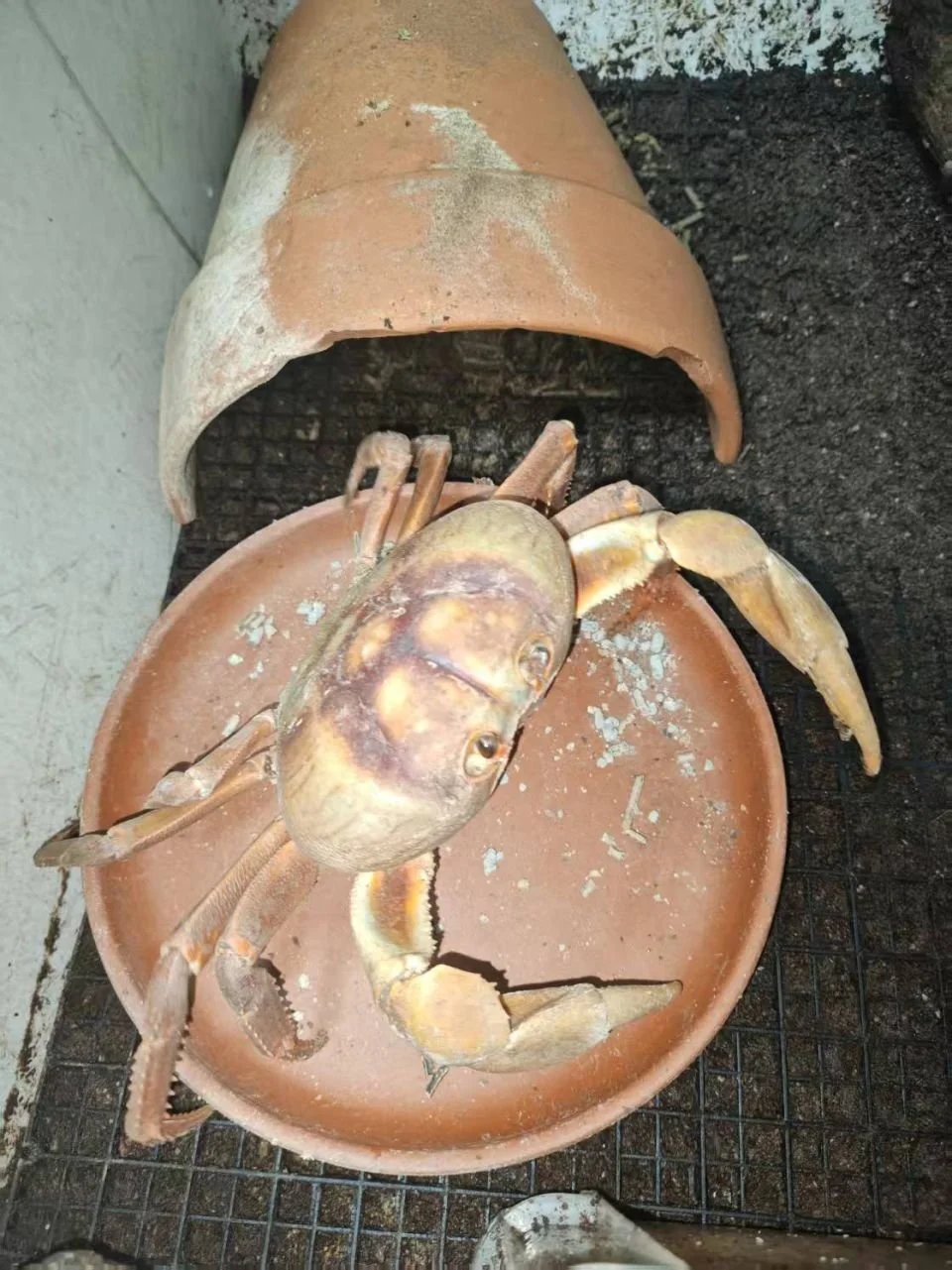
The first method of enclosure is known as the “Dark” method. It was popularized by Chinese keepers in the early 2000s and remains the most successful method of crab care in the hobby. However, this method is regarded as abusive by many, and results in the crab having faded colors.
Dark Method Pros
Cheapest method
Provides an “idiot proof” way of keeping most species
It is successful for every species as an individual, and successful for most when cohabbing
Allows for a greater variety of species to be kept in a space-efficient way
Dark Method Cons
You can’t observe your crab as well
Can smell
May require much more maintenance
Crab gets faded colors and looks less attractive
Crab is unable to move much or receive enrichment
Morally questionable




The Love Method
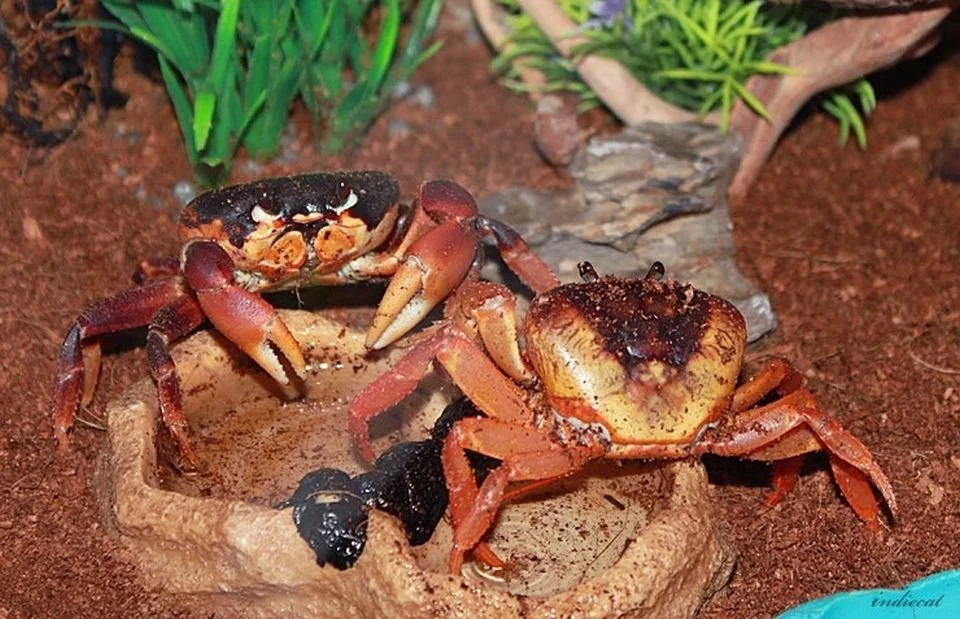
The second is the “Love” method. This method seeks to replicate a natural environment, giving the crab a space which allows you to witness the crab interacting in its natural habitat. This method is popularized by the Western keepers, and many Koreans have also attempted to help find successful Love methods. Successful methods are important, because a large portion of our species will fail to molt or die of stress in a love method. It is unknown to us what causes most of these failures, however we do have hypotheses.
Love Method Pros
With many species, you can create a biotope with multiple animals in it
A beautiful scape can frequently be made
Often will feature a water section which can have shrimp, snails, and fish
Crabs have the brightest colors and are most active
Crabs can be observed through glass or acrylic
Works better for cohabbing species
Natural behaviors are witnessed
Doesn’t feel like abuse
Love Method Cons
Not available for every species: some species of crabs refuse to live in a love method. It is our goal to discover a successful love method for every species, but successes sometimes seem impossible
More expensive
The cycle can sometimes crash if certain things happen, leading to the death of the crabs
In select species, green algae are observed to form on the mouth of the crab, and the crab will die soon after




Additional Notes
Dark method and love method aren’t things well known about, and care info on crabs is lackluster and often harmful. If you’re looking to learn more about crabs, I suggest joining the Discord, where more info is present.
The Dark Method is a way of keeping crabs popularized by the Chinese keepers. It can be kind of controversial within our community, with some people swearing by it, and some people calling it abusive. Regardless of how moral it is, it seems to be the actually best way to keep many species, where they only survive in a dark method and die otherwise. A dark method is usually just a tub with wet gravel/crushed coral or sometimes dirt. It replicates a crab’s natural burrow by being warm, humid, small, and dark. It’s widely regarded as the best way to keep any singular crab; the crabs are kept in very unstressful environments, and there aren’t any species that won’t live in a dark method.
A Love Method is the other way of keeping crabs. It’s popularized by Western culture and Korea. I guarantee if you’ve seen a crab online or looked into crab keeping, you’ve seen a love method. Its goal is to create a naturalistic environment, replicating where they come from. It usually has plants, enrichment, and a viewing area such as glass. Love methods are how you keep crab species if you want to display them, but the issue is that we have species in the hobby which don’t survive in a love method. We’ve yet to figure out why these species die in them, but they just don’t survive. Regardless, the goal with many crab keepers is to discover how to create a love method where the crabs survive in.
Both methods have their pros and cons, but the method which consistently sees success with crabs is a dark method. Love methods are more preferred by people because they get to watch their crab as it sits in a hole all day.