
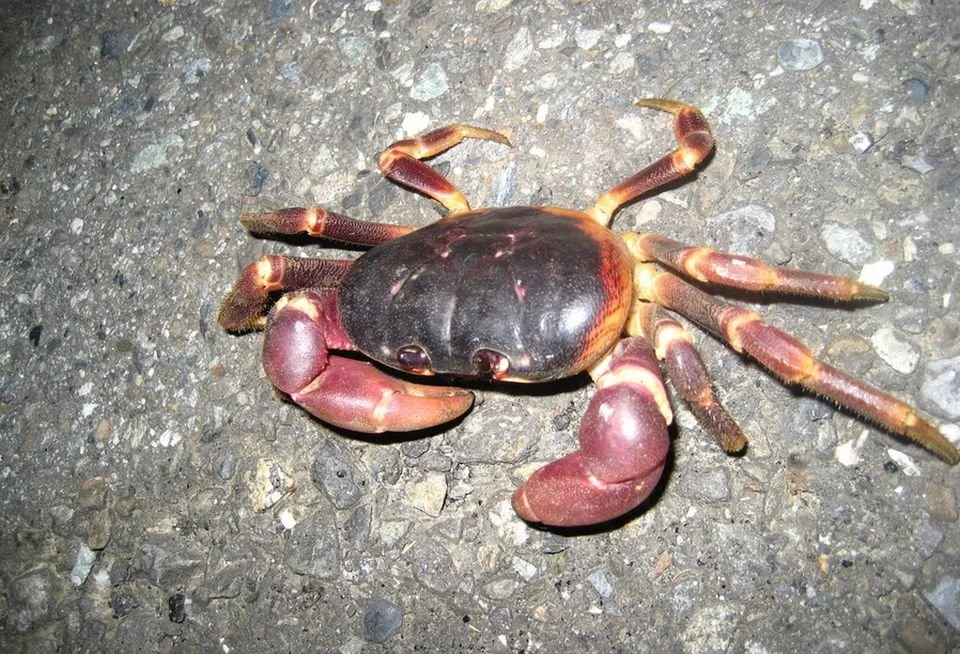
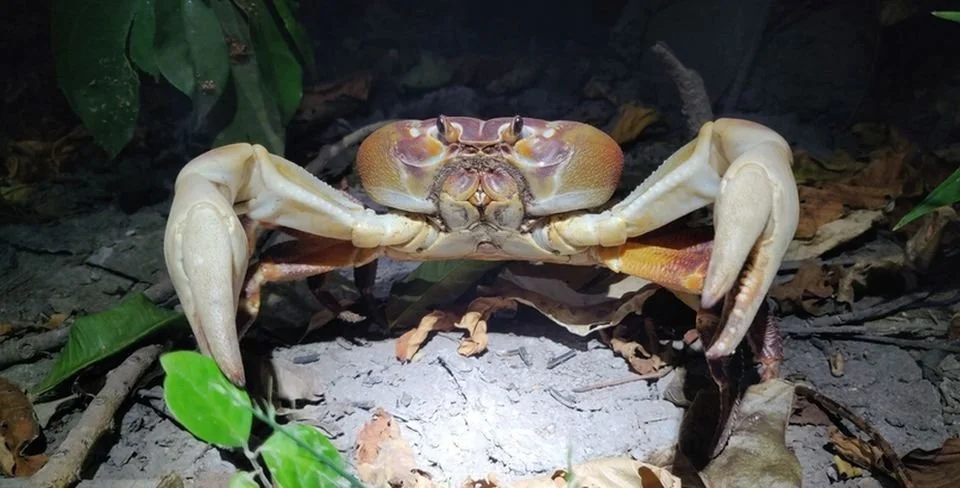
Purple Land Crab (Gecarcoidea lalandii).
Gecarcoidea is a genus of large, powerful terrestrial crabs originating from Southeast Asia and Oceania. Although often labelled as freshwater crabs in the trade, they are better described as terrestrial crabs with a need for freshwater access and dietary sodium.
These crabs are becoming increasingly common in the exotic pet trade, but all specimens available as of now are wild-caught—bringing both benefits and real challenges in terms of hardiness, strength, behaviour, and ethical sourcing.
Gecarcoidea Care Guide (G. lalandii & G. humei)
Gecarcoidea Care FAQs
Are Gecarcoidea (Purple Land Crabs) freshwater or brackish crabs?
Neither strictly aquatic nor brackish. Physiological experiments on Gecarcoidea lalandii demonstrate that they are terrestrial land crabs that hydrate mainly by immersing in freshwater—strongly preferring freshwater over seawater—while obtaining salts from food.
Jump to: Enclosure & Freshwater Immersion →Can you keep Gecarcoidea in a standard planted paludarium?
No. Their aggressive digging and sheer physical strength allow them to uproot plants, tear apart hardscape, and flip standard dishes. Aesthetic “Love Method” setups are strictly advanced.
Jump to: Enclosure & Environment →How do you tell Gecarcoidea humei apart from Gecarcoidea lalandii?
Look closely at the eye sockets (orbital rims) and upper carapace: G. humei has bright or white orbital borders, a brownish-red body, and three bold white carapace lines, whereas G. lalandii has dark orbital rims blended with its carapace plus yellow/orange triangular points directly below the eyes.
Jump to: G. humei vs. G. lalandii ID →How do Gecarcoidea crabs molt, and should I move them?
Unlike aquatic crabs, Gecarcoidea are true land crabs that molt on land inside damp burrows or dark shelters. Never dig up or disturb a molting crab, keep humidity steady at 80%, and leave the shed exoskeleton inside so the crab can eat it for calcium.
Jump to: Molting on Land →Can you cohabitate Gecarcoidea crabs?
Avoid cohabitation. Housing multiple Gecarcoidea together is entirely luck-based and depends on individual crab personalities—while a few crabs occasionally bond, housing multiples usually leads to fighting and injury.
Jump to: Cohabitation & Handling →What should you feed Gecarcoidea land crabs, and what salt is safe?
Feed a balanced mix of vegetables, fish pellets, and shrimp/seafood (essential because genomic sequencing in G. lalandii shows they cannot synthesize marine LC-PUFA fatty acids from plant diets alone). Once a week, roll a shrimp in pure marine aquarium salt or additive-free sea salt—never iodized table salt.
Jump to: Diet & Salt Supplementation →How to Tell Gecarcoidea humei Apart from Gecarcoidea lalandii
Two species regularly turn up in the exotic pet trade—often mixed together or mislabelled simply as “Purple Land Crab” or “Gecarcoidea”: Gecarcoidea humei and Gecarcoidea lalandii. For decades G. humei was treated as a synonym of G. lalandii, until a 2017 systematic revision (Lai, Shih & Ng, 2017) formally separated them based on genetics, morphology, and colouration.
In the wild, G. lalandii ranges widely across Southeast Asia and the West Pacific, whereas G. humei inhabits islands and coasts of the eastern Indian Ocean (with Christmas Island being the only known overlap zone alongside G. natalis). The easiest way to tell them apart is by checking their eye sockets (orbital rims) and carapace markings.
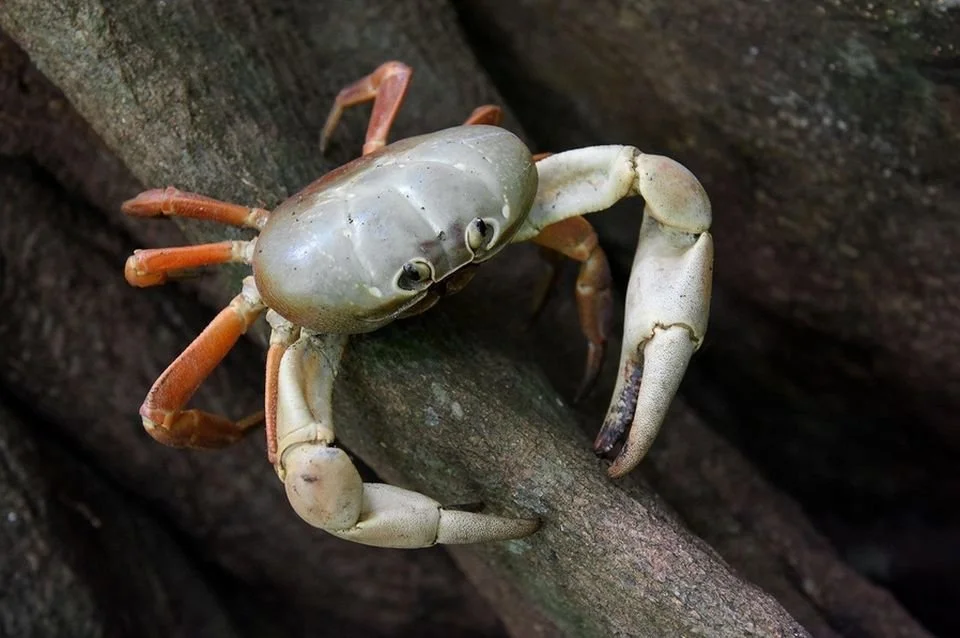
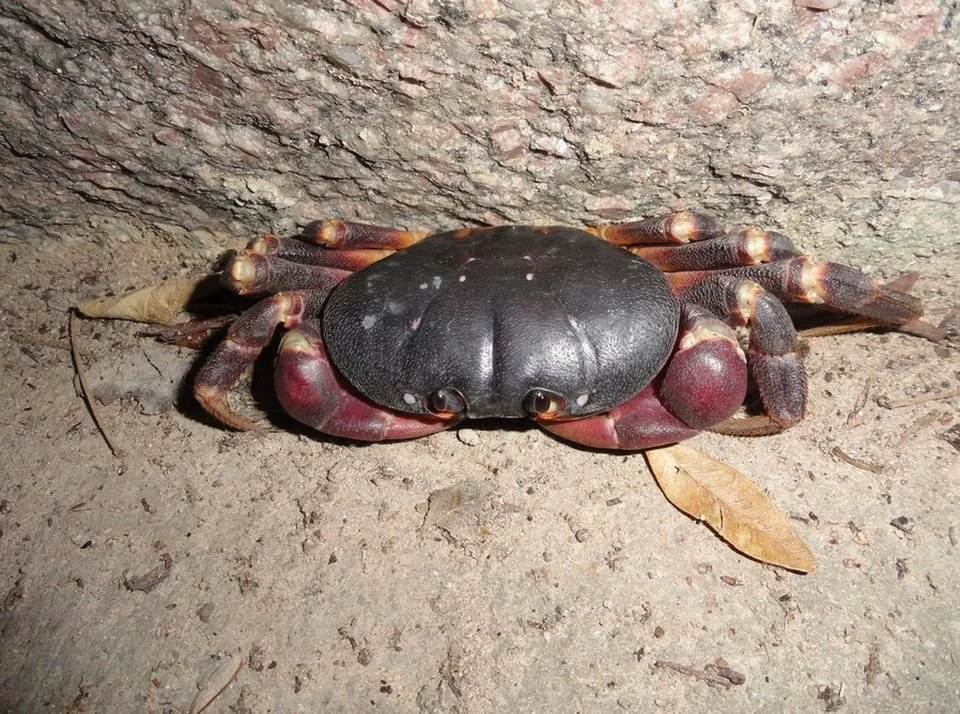
While G. humei’s eye sockets are painted in very bright colours, including white, G. lalandii’s eye sockets are blended seamlessly with the colours of its carapace and underside.
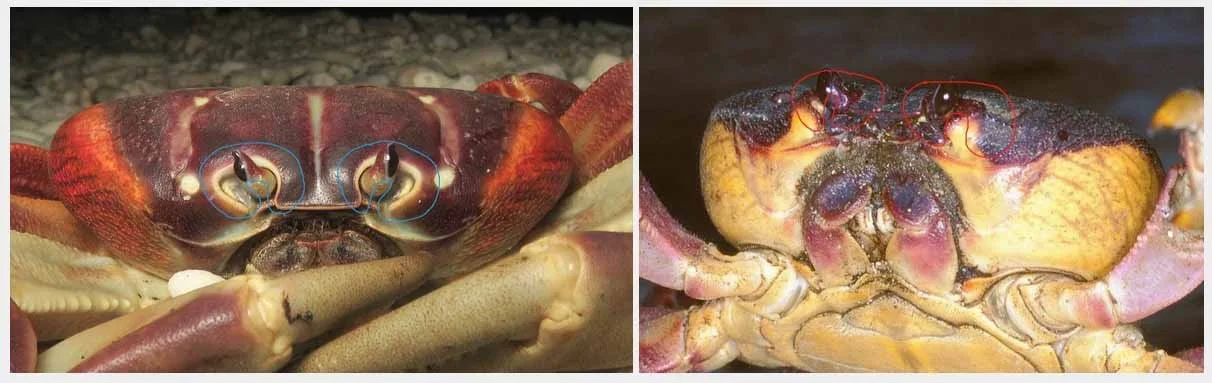
| Feature | Gecarcoidea lalandii | Gecarcoidea humei |
|---|---|---|
| Body & Sides Colour | Yellow/orange tones on the sides or carapace (with purple tones) | Body (sides or carapace) appears brown/red |
| Border Under Eyes | Clear orange or yellow triangular points right under the eyes | Vague colour border without a clear triangular point under the eyes |
| Carapace Pattern | Pattern looks naturally blended with the carapace colour | Three white carapace lines stand out sharply / feel intrusive |
| Orbital (Eye) Rim | Eye area blends seamlessly with the carapace colour (dark rim) | Brightly coloured or white border around the eye socket |
Quick Identification Key
- Does it look like there is yellow/orange on the sides or carapace? → Gecarcoidea lalandii
- Are there orange or yellow triangular points right under the eyes (around the border)? → Gecarcoidea lalandii
- Does the carapace pattern look naturally blended with the carapace colour? → Gecarcoidea lalandii
- Does the eye area (orbital area) blend in with the colour of the carapace? → Gecarcoidea lalandii
- Does the body (sides or carapace) appear brown/red? → Gecarcoidea humei
- Is the colour border vague without a clear point right under the eyes? → Gecarcoidea humei
- Does the carapace pattern (three white lines) stand out or feel intrusive? → Gecarcoidea humei
- Does it look like there is a white/bright border around the eye (orbital area)? → Gecarcoidea humei
Adult Size, Growth & Sexing (G. lalandii)
Field research on Gecarcoidea lalandii (Liu & Jeng, 2007; Phan et al., 2021) shows that crabs reach sexual maturity at around 42–54 mm (~1.7–2.1 in) carapace width, while fully grown adults regularly reach 100–150 mm (4–6 inches) across the carapace—not counting their long walking legs.
- Sexing adults after the puberty molt: In mature G. lalandii, males develop a noticeably larger major claw (chela) and a narrow, triangular abdominal flap (pleon) tucked underneath, whereas females have a wide, rounded abdomen built to hold eggs.
Conservation, Wild-Caught Status & Trade Origins
Conservation level: Not officially evaluated. All Gecarcoidea specimens currently available in the pet trade are wild-caught—primarily because captive breeding is not viable in standard home enclosures. Field studies on Gecarcoidea lalandii (Liu & Jeng, 2007; Ting et al., 2021) show that females carry hundreds of thousands of eggs (473,000–820,000 recorded) and migrate to coastal tidal zones to release planktonic marine larvae that require open ocean development.
Furthermore, taxonomic surveys by the Lee Kong Chian Natural History Museum (Ng et al., 2021) note that alongside G. lalandii exports from Southeast Asia, large numbers of Gecarcoidea humei have been wild-collected from southern Java, Indonesia for international export to Europe, China, and Japan. Local island harvest reports on G. lalandii also highlight that heavy collection pressure can deplete localized populations—making responsible, long-term care essential whenever you take on a wild-caught crab.
Care Level: The Dark Method vs. The Love Method
Because of their sheer power, sensitivity to disturbance, and burrowing drive, care difficulty depends heavily on which keeping style you choose. You can read our full breakdown in What Is the Dark Method for Keeping Crabs?
- Dark Method — Beginner: Suitable for keepers who follow the “Dark Method” of keeping crabs. Usually housed in an opaque tub with damp crushed coral or medium gravel, it replicates the warm, humid, dark conditions of a natural burrow—minimizing stress and preventing plant destruction. Field ecology on the closely related Christmas Island red crab (Gecarcoidea natalis; Green, 2004) confirms that Gecarcoidea rely on long-lasting burrows (persisting 5+ years) for thermal stability and moisture, explaining why Dark Method setups work so reliably.
- Love Method — Advanced: Keeping Gecarcoidea in a naturalistic glass display enclosure with substrate and lighting is considered advanced. Proceed with extreme caution and always be prepared to move your crab into a Dark Method setup if it fails to settle or struggles around molting.
Enclosure, Freshwater Immersion & Escape-Proofing
This species cannot be kept in a standard paludarium. Gecarcoidea crabs will rip up all your plants and tear apart traditional decorative layouts. Instead, build a rugged, escape-proof terrestrial enclosure centered around stability and strength:
| Parameter | Recommended setting |
|---|---|
| Minimum Tank Size | 45 × 45 × 45 cm (18 × 18 × 18 in); upgrade to wider footprint (e.g., 60 × 45 cm) for full 10–15 cm adults |
| Temperature | 27°C (80°F) |
| Humidity | 80% |
| Lighting | Provide a natural day-night cycle |
| Water Access | Large, heavy dechlorinated freshwater immersion bowl (unflippable) |
Why an Immersion-Sized Freshwater Bowl Matters (Not Brackish)
Behavioural osmoregulation studies directly on Gecarcoidea lalandii (Combs et al., 1992) revealed two crucial facts for keepers:
- They hydrate through immersion, not just sipping: Unlike coconut crabs (Birgus latro), which spoon water with their claws, G. lalandii obtains water primarily by immersing itself—meaning your heavy bowl should be wide and deep enough for the crab to submerge its lower body and gill openings, with a rough stone or textured exit so it can climb out easily.
- Freshwater only in the bowl: In controlled choice tests, G. lalandii consistently preferred freshwater over seawater and restored blood osmolarity solely through freshwater immersion. Ignore pet-shop claims that they need a brackish pool—always fill the bowl with clean, dechlorinated freshwater and scrub/refresh it frequently, as large crabs foul bowls fast.
- Never mist with saltwater: Maintain 80% humidity by misting with plain dechlorinated freshwater. Salt does not evaporate and will accumulate to dangerous levels in the substrate if misted.
Escape-Proofing & Lid Security
With long, muscular legs and strong leverage, Gecarcoidea are notorious escape artists. Secure the enclosure with a weighted, clipped, or locking lid, seal any gaps around thermostat probes or cables, and keep hides or stones well clear of the upper rim and silicone corners so your crab cannot lever the lid open.
Substrate Options
Your substrate choice depends directly on which husbandry method you are using:
- Dark Method: Crushed coral or medium gravel works best—keeping conditions clean, humid, and straightforward while supporting safe airflow and moisture retention.
- Love Method (Advanced): Normal organic potting soil works for naturalistic burrowing setups, provided the tank is deep and sturdy enough to handle heavy excavation.
Molting on Land & Longevity
Desiccation experiments on Gecarcoidea lalandii (Harris & Kormanik, 1981) show that while these crabs cut urine output sharply to conserve water during dry conditions, they depend on humid microclimates to avoid dehydration stress. That moisture stability becomes life-or-death during molting.
Unlike fully aquatic crabs that submerge to shed, true terrestrial gecarcinids molt on land inside a humid burrow or dark shelter, using internal fluid and air pressure to expand their soft new shell:
- Pre-molt signs: Expect loss of appetite, prolonged hiding or burrowing, sluggishness, and a slightly duller shell appearance.
- Never disturb a molting crab: Do not dig up burrows, lift hides, or handle a crab during pre-molt or right after shedding—soft-shell crabs are fragile and easily killed by stress or physical pressure.
- Leave the shed exoskeleton (exuvia) inside: After molting, the crab will eat its discarded shell to reclaim calcium and minerals needed to harden the new carapace.
- Longevity expectation: While exact captive lifespans for G. lalandii and G. humei are still being documented, studies on the closely related Gecarcoidea natalis estimate terrestrial gecarcinids can live 10–20+ years in the wild—so treat this as a long-term commitment when housed properly.
Cohabitation, Temperament & Safe Handling
Avoid cohabitation. Keeping multiple Gecarcoidea together is entirely luck-based and depends solely on the individual personalities of your crabs. There doesn’t seem to be a predictable rhyme or reason—crabs will occasionally bond, while most other pairings will fight and seriously injure or kill each other, especially around food or molting. House each crab individually unless you are deeply experienced and have spare enclosures ready.
Diet, Essential Fatty Acids & Salt Supplementation
Genomic and biochemical research directly on Gecarcoidea lalandii (Ting et al., 2021; Ting et al., 2022) found a remarkable dietary limitation: while G. lalandii possesses fatty acid elongase genes, it lacks the front-end desaturase enzymes needed to manufacture essential marine long-chain polyunsaturated fatty acids (EPA, DHA, and ARA) from plant fats alone.
This gives scientific backing to feeding a balanced omnivorous menu rather than vegetables alone—while studies on related Gecarcoidea natalis (Linton & Greenaway, 2000) also highlight the value of natural dried leaf litter alongside protein:
- Core diet: Feed a varied balance of vegetables, fish pellets (rich in marine meal/fatty acids), and shrimp, optionally supplemented with safe dried hardwood leaf litter.
- Sodium-rich foods: Because G. lalandii conserves ions through antennal-gland/gill urine reprocessing while hydrating in freshwater (Kormanik & Harris, 1981), dietary sodium is vital—prioritize seafood and celery regularly.
- Weekly sea-salt supplement: Once a week, roll a piece of shrimp in pure marine aquarium salt or additive-free sea salt before feeding to supplement the crab with salt. Never use iodized table salt or kitchen salts containing anti-caking agents.
A Quick Note on Gecarcoidea natalis (Christmas Island Red Crab)
The third member of the genus is the famous Christmas Island red crab (Gecarcoidea natalis), endemic to Christmas Island and the Cocos (Keeling) Islands in the Indian Ocean. Unlike G. lalandii and G. humei, G. natalis is strictly protected in the wild and is not legally available in the exotic pet trade.

- Primary Husbandry Data: Gathered by co-author Albomita and the team at Crustacean Council; Indoor Ecosystem Dark Method Standards.
- Systematics & Distribution (G. humei vs. G. lalandii): Lai, J. C. Y., Shih, H.-T., & Ng, P. K. L. (2017). The systematics of land crabs of the genus Gecarcoidea and recognition of a pseudocryptic species, G. humei, from the eastern Indian Ocean. Invertebrate Systematics, 31(4), 406–426. doi:10.1071/IS16052; plus Ng, P. K. L., et al. (2021), Lee Kong Chian Natural History Museum (documenting G. humei imports from southern Java).
- Freshwater Immersion & Osmoregulation (G. lalandii): Combs, C. A., Alford, N., Boynton, A., Dvornak, M., & Henry, R. P. (1992). Behavioral Regulation of Hemolymph Osmolarity Through Selective Drinking in Land Crabs, Birgus latro and Gecarcoidea lalandii. The Biological Bulletin, 182(3), 416–423. doi:10.2307/1542261
- Water Balance & Desiccation Physiology (G. lalandii): Kormanik, G. A., & Harris, R. R. (1981) & Harris, R. R., & Kormanik, G. A. (1981). Salt and water balance and antennal gland function in three Pacific species of terrestrial crab (Gecarcoidea lalandii, Cardisoma carnifex, Birgus latro). Parts I & II. Journal of Experimental Zoology, 218(1), 97–116. doi:10.1002/jez.1402180112
- Fatty Acid Biochemistry & Diet Needs (G. lalandii): Ting, S. Y., et al. (2021). Long-Read Sequencing Reveals the Repertoire of Long-Chain Polyunsaturated Fatty Acid Biosynthetic Genes in the Purple Land Crab, Gecarcoidea lalandii. Frontiers in Marine Science, 8, 713928. doi:10.3389/fmars.2021.713928 (and 2022 follow-up in Comparative Biochemistry and Physiology Part B).
- Maturity Size, Sexing & Larval Release (G. lalandii): Liu, H.-C., & Jeng, M.-S. (2007), Zoological Studies, 46(3): 347–354; Phan, M.-T., et al. (2021), Annual Research & Review in Biology, 36(1): 111–120.
- Burrow Persistence & Longevity (Congener G. natalis): Green, P. T. (2004). Burrow Dynamics of the Red Land Crab Gecarcoidea natalis in Rain Forest on Christmas Island. Journal of Crustacean Biology, 24(2), 340–349. doi:10.1651/C-2447; Linton, S. M., & Greenaway, P. (2000, 2007).
Explore More Crab Husbandry & Naturalistic Ecosystems
Want to dive deeper into crab care, organic enclosures, and specialist crustacean setups? Check out the Indoor Ecosystem ebook collection or join our Discord community for live help with rare land crabs.
View the Ebook Collection