
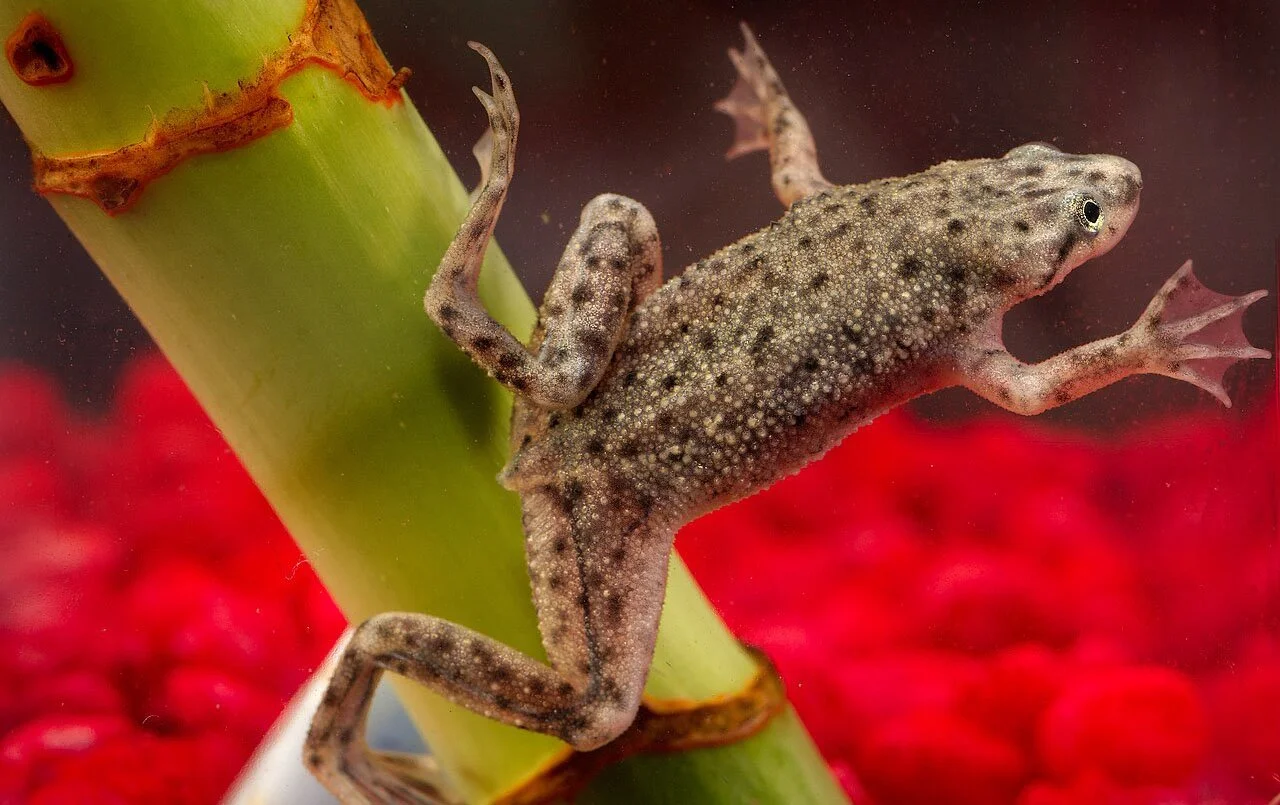
Picture: By James Gathany
African dwarf frog (ADFs) are quite often misunderstood in the aquarium hobby. They’re peaceful, quirky, and full of personality, but only when kept in the right conditions. Unfortunately, they’re often sold as “community tank compatible,” which leads to stress, injury, and shortened lifespans. So the aim of this guide is to teach you proper care so you can keep them happy and healthy for as long as possible.
Tank Mates for African Dwarf Frogs: Why Species-Only Is Best
ADFs do best in species-only aquariums.
Primary reasons:
Poor vision & feeding behavior
ADFs rely on movement and smell to find food.
They may accidentally grab at fish or snails, or confuse them with food, causing injury or death to tank mates.
Stress from other species
Even peaceful fish can out compete them for food.
Constant movement from fish creates stress in shy frogs.
Health & lifespan
Chronic stress can weaken immune systems.
This leads to higher disease risk and shorter lifespans.
A common misconception is that they can live with peaceful fish like Betta splendens. Even if the fish seems calm, ADFs can still be harassed, stressed, or accidentally injured due to misdirected bites or competition for space and food. The same goes for the betta fish as well. Frogs will nip fish fins sometimes, which is a major issue for long finned betta fish.
African Dwarf Frogs With Fish: Wild Behavior vs Aquarium Reality
In nature, African dwarf frog exist in environments where fish are present. However, this does not automatically translate to aquarium compatibility.
In their natural habitat:
Water systems are vast and continuous, not confined
Fish and frogs have enormous space to avoid one another
Interactions are brief and diffuse, not constant or unavoidable
Frogs can freely retreat, spread out, and occupy large territories
In contrast, home aquariums:
Are closed, high-density systems
Force constant proximity between species
Limit escape routes and personal space
Concentrate feeding competition and movement
This difference in spatial scale is the primary reason compatibility changes dramatically in captivity.
Why “They Live Together in the Wild” Doesn’t Mean Tank Compatibility
Even though ADFs and fish may coexist in nature, aquarium conditions change the dynamic:
Reduced separation distance: In tanks, frogs and fish are always within interaction range
Feeding competition: Fish typically outcompete frogs for food unless carefully managed
Stress from constant presence: Even non-aggressive fish create continuous stimulation and pressure
Accidental injury risk: ADFs rely heavily on movement-triggered feeding responses, which can lead to mistargeting tankmates
So while coexistence is biologically possible, it is often behaviorally and practically incompatible in captivity.
Vertical Space & Behavior Expression
ADFs are not strictly bottom-dwelling animals. In properly structured environments, they use the full water column.
Typical healthy behaviors include:
Floating and hovering mid-water
Resting on plants or décor in “spread-out” positions
Surfacing to breathe regularly
Long periods of still “burbling” at the surface
Active swimming across all tank levels
However, vertical space use can vary depending on:
Tank footprint and enrichment
Water quality stability
Group size and social comfort
Presence of other species
Rather than a simple “happy vs unhappy” indicator, vertical distribution is one of several behavioral signals that should be interpreted alongside:
Feeding response
Activity levels
Interaction between frogs
Time spent hiding vs exploring
Social Needs: They Need Their Own Kind
ADFs are social animals and should never be kept alone.
Keep at least 2–3 minimum, though groups are better
They recognize and interact with each other
Being alone or with fish can lead to:
Reduced activity
Hiding constantly
Stunted natural behaviors
When kept properly, they display:
Floating and “hovering” behavior
Group swimming
Playful bursts of movement (“zoomies”)
Relaxed resting in open areas
Tank Size & Setup
Minimum recommendations:
10 gallons: OK starter for up to ~3 frogs
20-gallon long: strongly preferred for 3–6+ frogs
While a 10 gallon tank is an option most people find 10 gallons becomes, dirty quickly, can be visually cramped and is less enriching long-term.
A 20-gallon long allows:
More swimming space
Better water stability
Room for plants and hides
More natural behavior expression
Ideal setup includes:
Soft substrate (sand preferred)
Dense live or silk plants
Hiding spots (caves, wood, decor)
Gentle filtration (low flow)
Easy access to surface for breathing
Feeding Behavior
ADFs are opportunistic hunters:
Feed frozen or live foods (bloodworms, brine shrimp, mysis shrimp)
Target feeding works best since they are slow and easily outcompeted
Many can learn spot feeding routines, which makes care much easier and more interactive
Stress & Health
ADFs are delicate amphibians and highly sensitive to poor conditions.
Stress factors include:
Aggressive or fast-moving tank mates
Inadequate feeding access
Overcrowding
Poor water quality
Chronic stress can lead to:
Weakened immune system
Increased disease risk
Reduced lifespan
Loss of natural behavior