
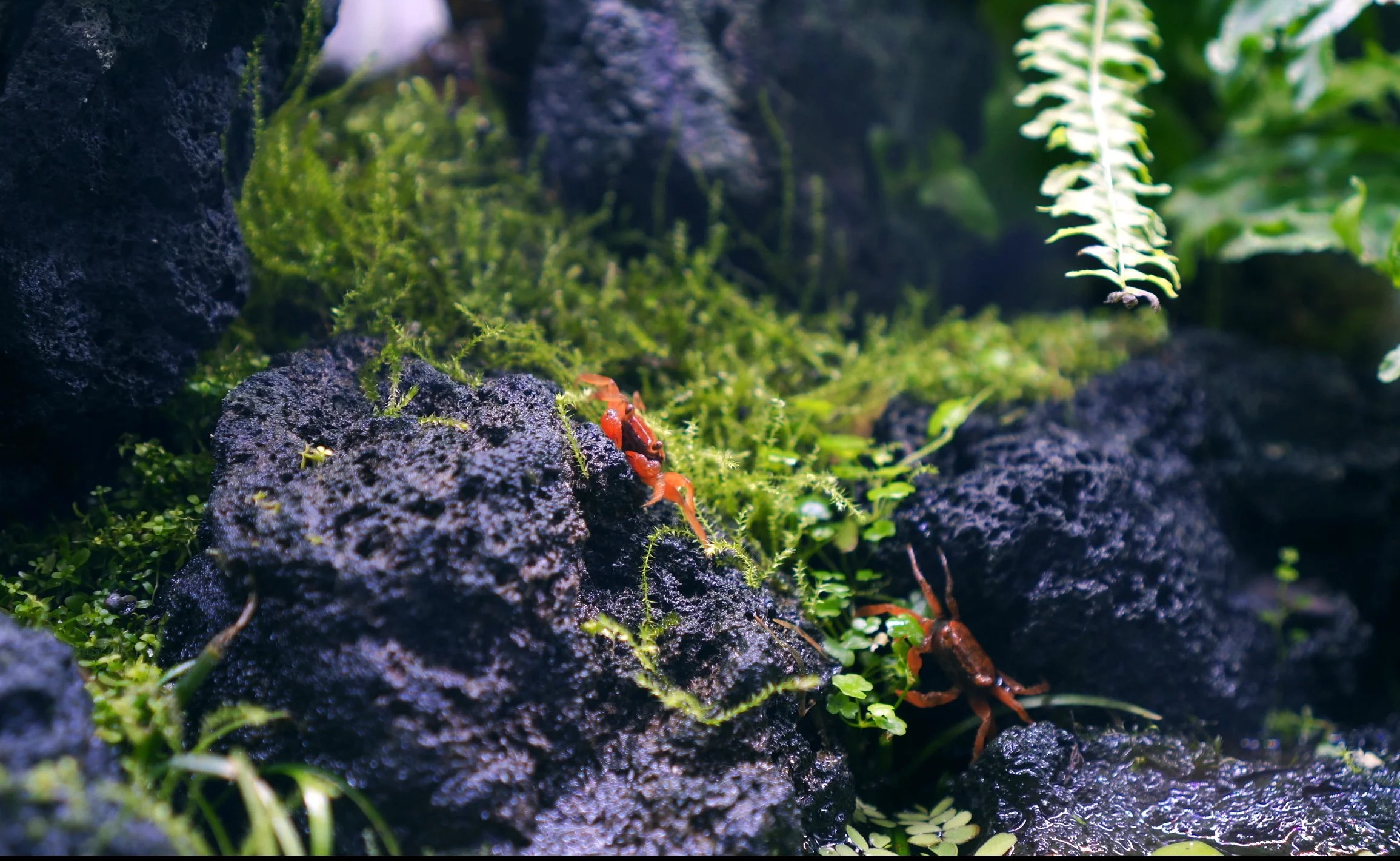
Telling the difference between male and female Geosesarma Vampire Crabs is one of the most important skills you need as a keeper. Whether you are trying to establish a peaceful breeding colony or just want to prevent constant territorial fights, getting your gender balance right is critical.
The good news is that the sexing process is identical across almost all Geosesarma species—whether you keep Purple Vampire Crabs (Geosesarma dennerle), Red Devils (Geosesarma hagen), Disco Crabs (Geosesarma tiomanicum), or any other color morph. In this guide, I will walk you through the two methods you can use to tell males and females apart, the stress-free clear container trick, the rare back-carrying species, and the latest scientific research on crab morphology.
How to Sex Vampire Crabs: Identifying Male & Female Vampire Crabs
Vampire Crab Sexing FAQs
How do you tell if a vampire crab is male or female?
The most accurate, 100% reliable method is inspecting the abdominal flap (apron) on the underside. Males have a narrow, pointed, triangular or inverted T-shaped flap. Females have a broad, semicircular, dome-shaped flap that covers almost their entire belly to carry eggs.
Jump to: The Flap Inspection Method →Can you sex vampire crabs by their claw size?
Yes, but it is only a secondary indicator. Mature male vampire crabs possess noticeably larger, bulkier claws (chelae) for fighting and display, while females have smaller, slender claws. However, in juvenile crabs or species where females develop moderate claws, claw size can be misleading.
Jump to: Claw Size Comparison →Do any vampire crabs carry their babies on their back?
Yes! Geosesarma notophorum (White Mandarin) and Geosesarma pontianak are the only two known species where females carry their young on their carapace (back) rather than under their abdominal flap.
Jump to: Back-Carrying Species →How do you check a vampire crab's underside without hurting it?
Never squeeze a crab with your fingers or flip it forcefully on a hard surface. Gently scoop the crab into the palm of your hand and place it inside a clean, clear plastic cup or glass container. You can then look through the bottom of the container to inspect the belly flap with zero stress to the crab.
Jump to: Safe Clear Container Trick →Why is the male-to-female ratio so important for vampire crabs?
Male vampire crabs are aggressive during mating. Housing a single male with a single female (1:1) often results in the male pursuing the female to death or severing her limbs. Always maintain a ratio of 1 male to 2 or 3 females.
Jump to: Why Sex Ratios Matter →How to Sex Vampire Crabs Video Guide
This is probably the most requested topic on the channel! If you prefer watching the visual comparison in real-time, this video demonstrates the exact differences between male and female Geosesarma crabs using live specimens and the clear container method:
The Two Sexing Methods Explained
Determining the sex of crab species can vary depending on the specific genus and their individual characteristics. However, when it comes to Vampire Crabs (Geosesarma), there are two distinct ways you can use to tell the difference between males and females:
- Method 1 (100% Flawless): The Abdominal Flap (Pleon). Checking the shape of the flap on the crab's belly. This is an anatomical guarantee and works on virtually every specimen once they reach sub-adulthood.
- Method 2 (Quick Visual Guess): Claw Size (Chelae). Looking at the overall size, thickness, and bulk of the claws. This is great for a quick glance, but can be tricky with young crabs or species where older females develop slightly larger claws.
Method 1: The Abdominal Flap (100% Accurate)
The single most reliable, scientifically backed way to determine the sex of any Vampire Crab is to look at its underside abdomen (known in crustacean biology as the pleon or apron). This is the fold of shell tucked tightly beneath the cephalothorax.
External Morphology: Male Vampire Crabs
Male crabs typically have a narrower, triangular-shaped abdomen that tapers sharply toward the telson (the tip of the tail). In mature specimens, it looks like a pointed pyramid, a narrow lighthouse, or an inverted "T" shape.
Because males do not carry eggs, their abdomen does not need to cover their belly. Beneath this narrow flap lies the male's specialized copulatory organs—the first gonopods (G1)—which are used to transfer spermatophores during mating.
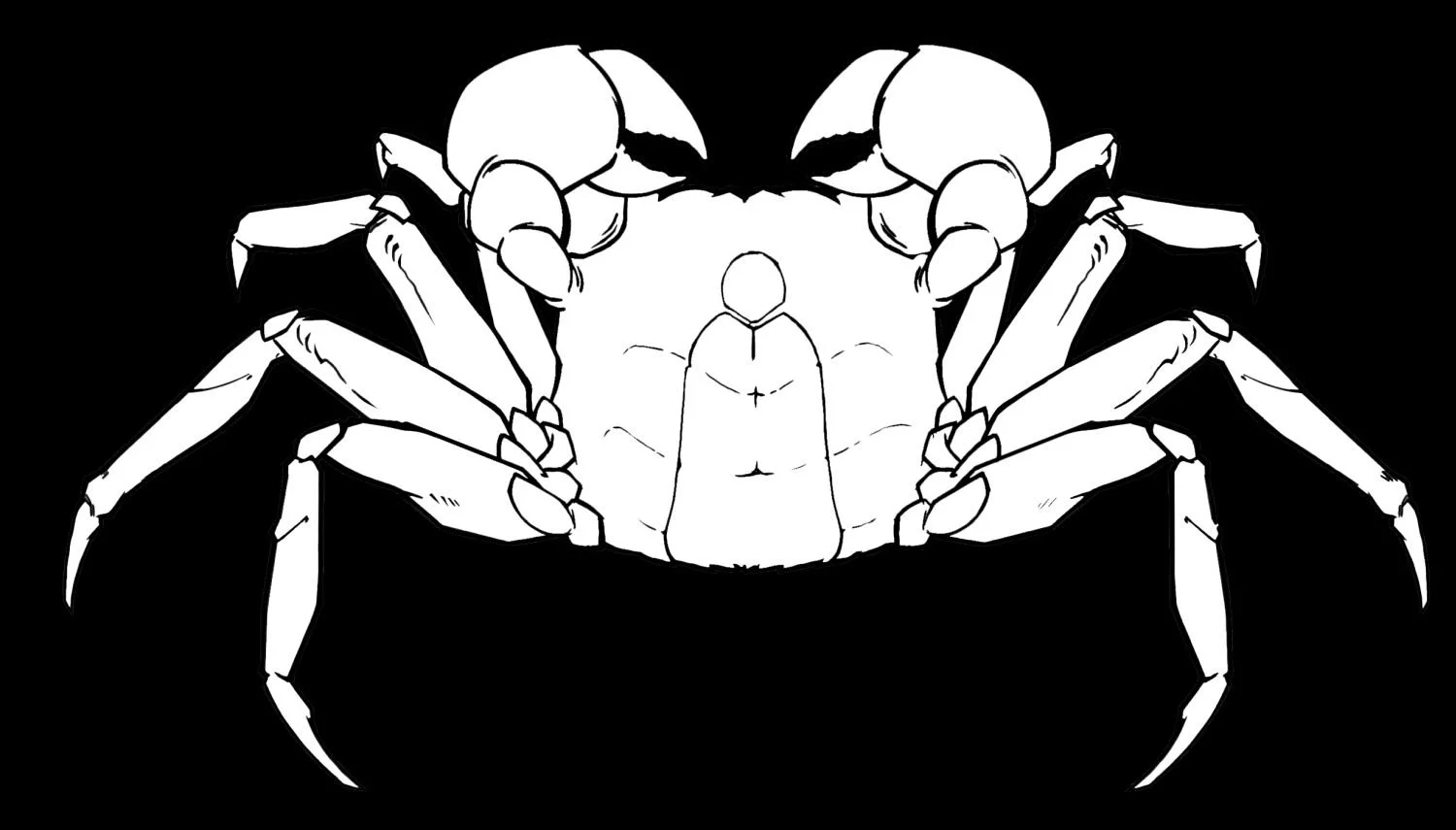
Illustration: Diagram of a male vampire crab underside showing the narrow, pointed triangular abdominal flap (apron).
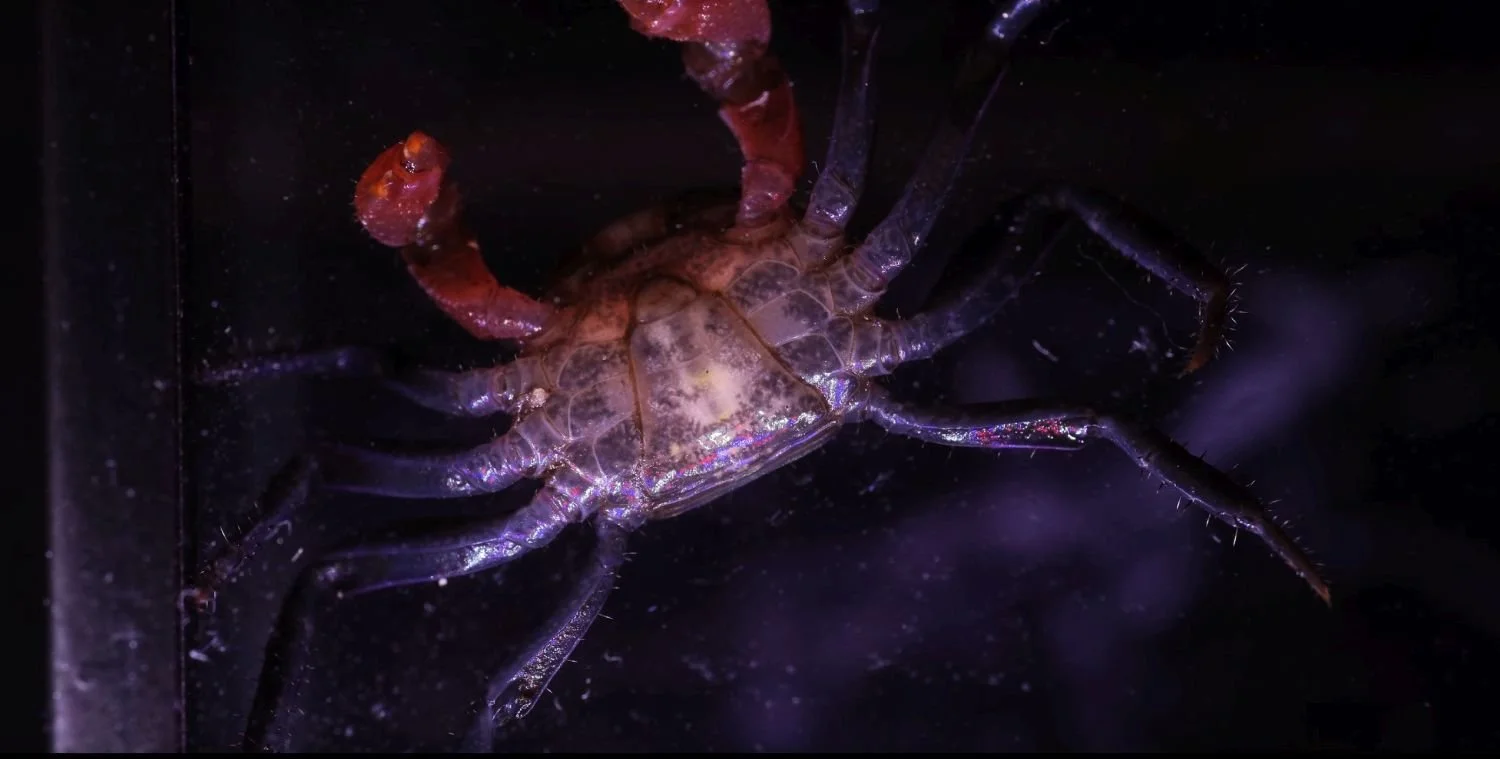
Picture: Male Geosesarma vampire crab underside view through a clear container, clearly showing the distinct narrow, pointed abdominal flap.
External Morphology: Female Vampire Crabs
Females, on the other hand, have broader, much more rounded abdomens that resemble a wide semicircle, horseshoe, or protective shield.
The female crab's wider abdominal flap is an evolutionary marvel designed specifically to carry and protect her eggs. When a female becomes gravid, her abdominal flap opens slightly, creating a deep, safe brood pouch where between 20 and 50 large, spherical eggs are anchored to her pleopods. This wide flap keeps the direct-developing hatchlings safe until they are ready to crawl out onto the moss.
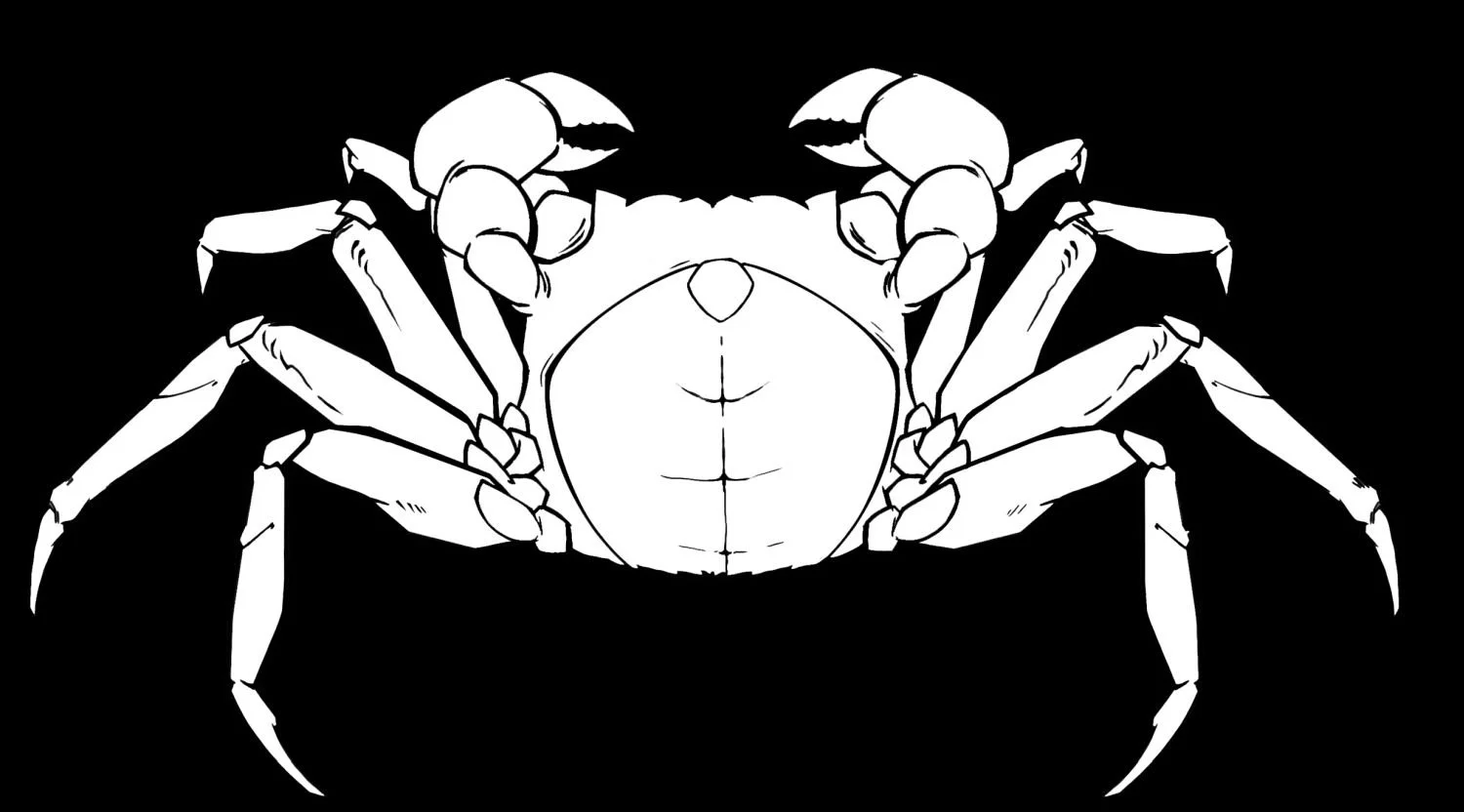
Illustration: Diagram of a female vampire crab underside showing the wide, rounded semicircular brood flap used to hold eggs.
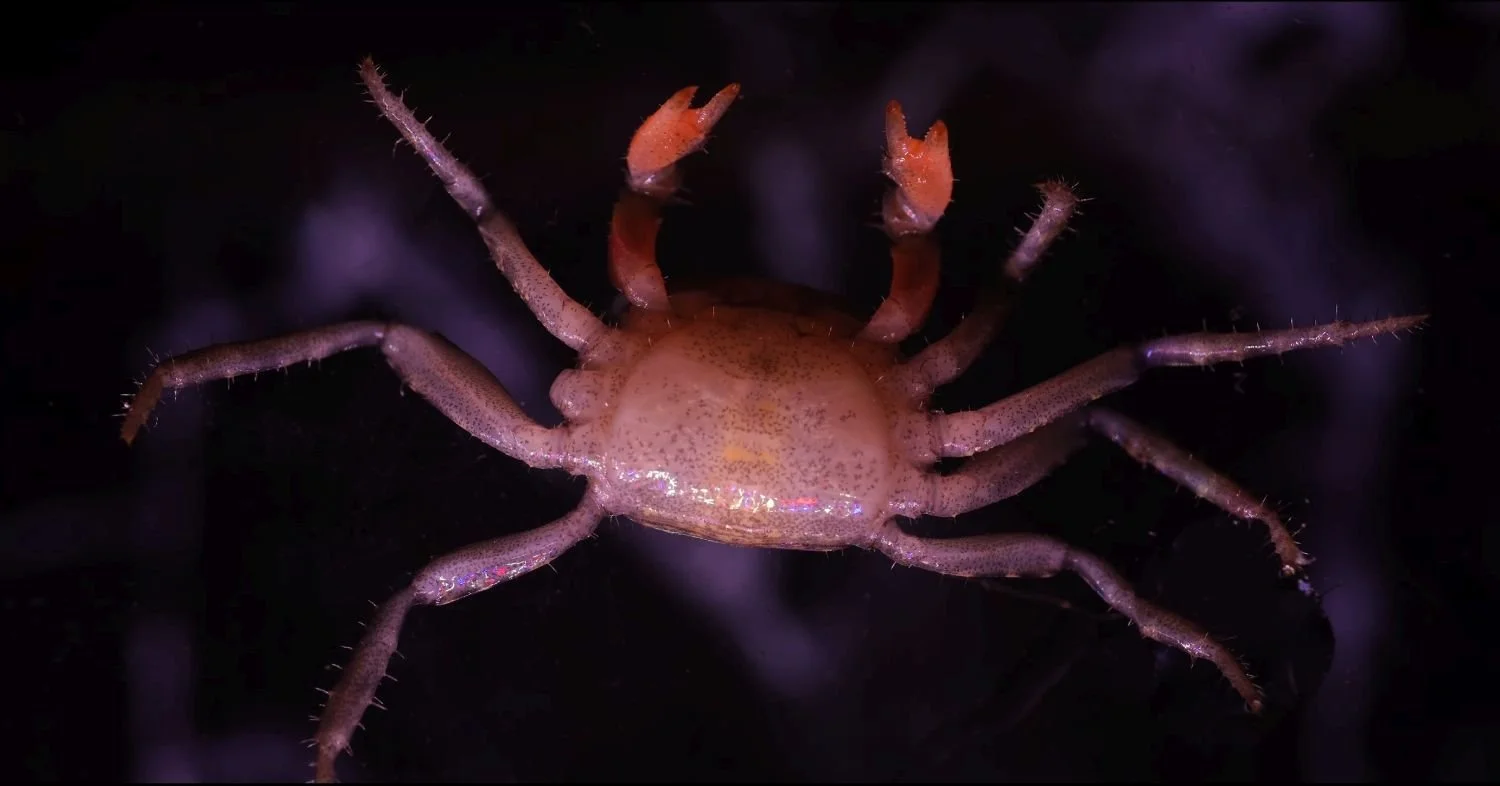
Picture: Female Geosesarma vampire crab underside view showing the broad, dome-shaped brood flap covering almost the entire belly.
The Safe Clear Container Inspection Trick
A lot of beginners make the critical mistake of trying to flip their crabs with their fingers or pinching their shell to look at the belly. Do not do this!
Vampire Crabs have delicate exoskeletons. Applying uneven pressure with your fingers can crack their carapace, crush internal organs, or trigger an autotomy reflex where the crab deliberately drops its claws and walking legs in panic. Furthermore, if a crab panics and falls from your hands onto a hard table or floor (even a fall of just 15 cm / 6 inches), the internal shock is almost always fatal within 24 to 48 hours.
How to Safely Check the Underside:
- Gently scoop the crab: Let the crab walk into a small cup, or gently scoop it into the open palm of your hand without squeezing.
- Place it in a clear container: Transfer the crab into a clean, clear plastic cup, clear Tupperware container, or a small glass jar.
- Look through the bottom: Hold the clear container up to the light and look directly through the transparent bottom. The crab will naturally sit flat against the base, giving you an unobstructed, crystal-clear view of its abdominal flap with zero physical stress.
- Release gently: Lower the container directly into the terrarium moss and let the crab walk out on its own.
Method 2: Claw Size & Visual Comparison
If you don't have a clear container on hand and need a quick visual estimate, you can look at the crab's front claws (known scientifically as chelipeds or chelae):
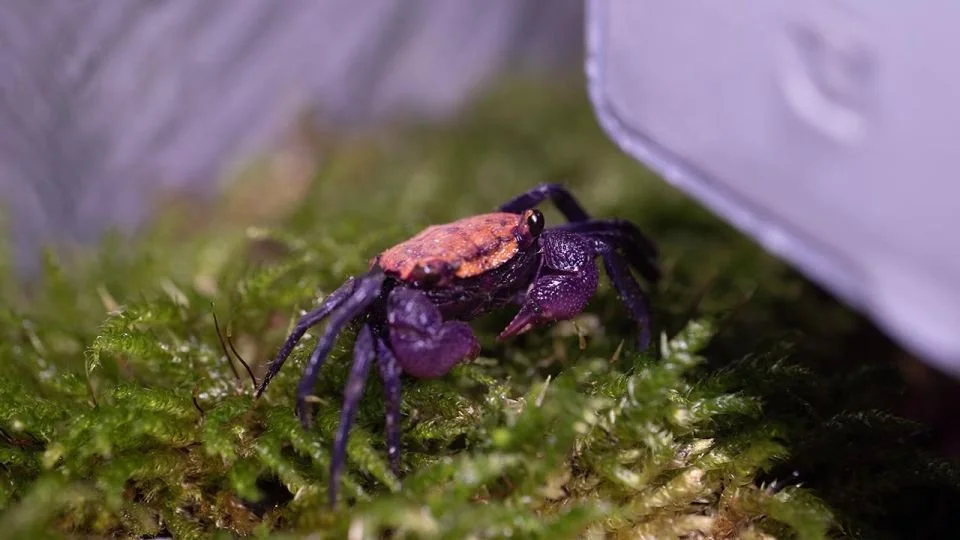
Picture: Male vampire crab front view showing the significantly larger, bulkier chelae (claws) used for territorial display and mating.
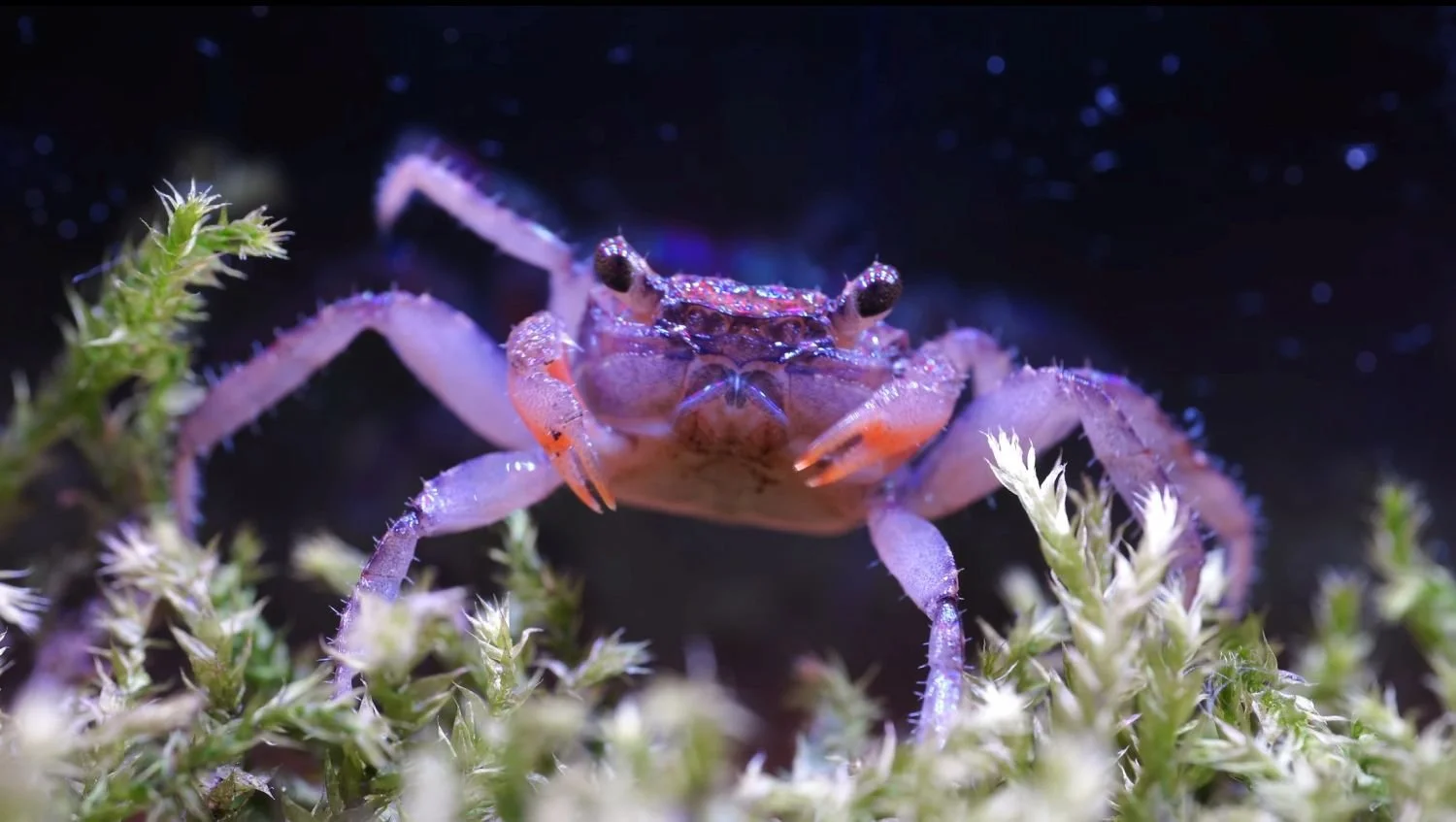
Picture: Female vampire crab front view showing proportionally smaller, more delicate claws adapted for precision feeding.
- Males: Adult males almost always develop noticeably larger, stouter, and bulkier claws. They use these enlarged pincers for territorial wrestling matches, warding off rival males, and forcefully pinning females during courtship. In species like Geosesarma hagen (Red Devil) or Geosesarma dennerle (Purple Vampire Crab), male claws often exhibit vivid, fiery coloration.
- Females: Females possess smaller, more delicate, and proportionally slender claws. Because female claws are used almost exclusively for precise feeding—picking microfauna, moss, and decaying leaf litter from the ground—they do not develop the heavy muscular bulk seen in males.
Size, Carapace & Secondary Sexual Traits
Beyond abdominal flaps and claw mass, mature Geosesarma crabs exhibit subtle secondary sexual characteristics:
1. Body Size & Carapace Shape
Males are generally slightly larger overall than females of the same age. The shape of the carapace (the hard upper shell) can also subtly differ: mature males often display a slightly more angular or elongated carapace outline, whereas females are marginally more rounded and squat to accommodate internal ovarian development.
2. Secondary Sexual Characteristics & Egg Brooding
During the active breeding season, males may display minor coloration flare-ups in their claws during aggressive territorial posturing. Females, meanwhile, provide the most obvious visual sign of all: carrying an egg mass. A gravid female's underside will appear visibly swollen, packed with a cluster of dark, miniature spheres tucked tightly beneath her abdominal flap.
The Incredible Exception: Crabs That Carry Babies on Their Back
While virtually all Geosesarma females carry their developing eggs and hatchlings securely beneath their abdominal flap, there is a mind-blowing exception in the genus: Geosesarma notophorum (White Mandarin Vampire Crab) and Geosesarma pontianak.
These are the only two known species in the entire genus where females carry their newly hatched young directly on their back (carapace), exactly like a wolf spider or scorpion! In fact, the species name notophorum literally translates from Greek as "back-bearer" (noton = back, phoros = carrying).

Picture: A female White Mandarin Vampire Crab (Geosesarma notophorum) carrying dozens of newly hatched crablets across her dorsal carapace—a unique behavior seen only in G. notophorum and G. pontianak.
Female White Mandarins initially carry a clutch of fertilized eggs under their abdominal flap for roughly 45 to 60 days. But as the direct-developing miniature crablets hatch, they climb up and anchor themselves across their mother's back, riding along with her for several weeks while continuing their development.
Video: Geosesarma Notophorum Breeding Cycle
Watch this incredible dorsal-brooding phenomenon up close in this video, where I document the breeding cycle of Geosesarma notophorum and capture rare footage of baby crablets riding on their mother's back:
If you discover a gravid female carrying eggs or babies, make sure to read our complete step-by-step guide on how to breed Vampire Crabs to ensure maximum hatchling survival!

Master Geosesarma Anatomy, Breeding & Husbandry
Looking to build high-yield breeding racks, optimize naturalistic paludariums, or prevent territorial fighting? The Indoor Ecosystem digital guide collection covers everything from crustacean taxonomy and anatomy to low-maintenance bioactive setup designs.
Explore the Guides & EbooksScientific Research on Geosesarma Morphology
The distinct morphological differences between male and female Vampire Crabs are thoroughly documented in peer-reviewed carcinological literature:
1. Taxonomic Description of G. dennerle & G. hagen (Ng, Schubart & Lukhaup, 2015)
In their seminal 2015 paper published in the Raffles Bulletin of Zoology (63: 3–13), world-renowned carcinologists Peter K. L. Ng, Christoph D. Schubart, and Christian Lukhaup formally diagnosed the two most popular aquarium species: Geosesarma dennerle and Geosesarma hagen from Central Java, Indonesia.
The study highlights that male Geosesarma possess a diagnostic male first gonopod (G1)—a chitinous, straight, slender organ with a spatuliform pectinated tip—paired with a narrow sixth pleonal somite. In contrast, female paratypes were defined by their broad, shield-like pleon that completely spans thoracic sternites 4 through 8, adapted specifically for brooding large, direct-developing eggs without a marine larval zoea phase.
2. Metabolic & Claw Dimorphism (Juarez et al., 2024, Stanford University)
In a groundbreaking 2024 physiological study on Geosesarma hagen led by Bryan H. Juarez and colleagues at Stanford University, researchers analyzed the functional biology behind claw dimorphism. The study confirmed that:
- Male claws are mechanically specialized for territorial defense and mate acquisition, exhibiting significantly higher muscle mass and cuticle thickness.
- Females, possessing smaller chelae, execute substantially more frequent feeding motions than males, utilizing both feeding claws in rapid alternation to sustain the higher energetic costs of egg production and gonad maturation.
Why Sex Ratios Are Life or Death in Your Paludarium
Accurately sexing your crabs isn't just an academic exercise—it is essential for their long-term survival in captivity. Gender imbalance is one of the most common reasons colonies collapse:
The Golden Ratio: 1 Male to 2 or 3 Females
In the wild, male Vampire Crabs establish small micro-territories along stream banks and actively intercept passing females. In an enclosed vivarium, space is restricted. If you keep a single male with a single female (1:1), the male will relentlessly pursue her day after day. Mating in Geosesarma is aggressive; males forcefully flip females onto their backs. A lone female will quickly suffer fatal exhaustion, severed limbs, or stress-induced mortality.
By providing at least 2 or 3 females per male (a harem structure), the male's attention is naturally divided, giving individual females time to forage, rest, and burrow safely.
The All-Female Community Tank
If you do not intend to breed your crabs and simply want a beautiful, display-only vivarium, an all-female colony is the safest setup possible. Female Vampire Crabs exhibit very little territorial aggression toward one another, rarely fight over burrows, and can be kept in higher densities without issue.
For safe tank stocking guidelines and minimum enclosure sizes, check our shrimp tank mates guide and our breakdown on what vampire crabs eat to keep your colony healthy!
Male vs. Female Vampire Crab Comparison Matrix
| Feature | Male Vampire Crab | Female Vampire Crab | Reliability Rating |
|---|---|---|---|
| Abdominal Flap (Pleon) | Narrow, pointed V-shape / inverted "T" | Broad, semicircular dome / horseshoe | 100% (Definitive) |
| Claw (Chelae) Size | Noticeably larger, bulkier, thicker | Smaller, slender, feeding-adapted | 85% (Tricky in juveniles) |
| Reproductive Anatomy | First gonopods (G1) under flap | Vulvae on sternite 6 + brood pleopods | 100% (Scientific) |
| Egg & Hatchling Carrying | Never carries eggs or babies | Carries eggs under flap (or back in G. notophorum) | 100% (When gravid) |
| Territorial Aggression | High (Fights other males; pins females) | Low (Peaceful; communal burrowing) | Behavioral Guide |
| Carapace Shape | Slightly more angular / elongated | Slightly wider / rounded rear margin | 70% (Subtle difference) |
Sexing Vampire Crabs is simple once you know what to look for. Always rely on the clear container underside method rather than guessing by claw size alone, maintain a healthy 1M:2–3F harem ratio, and ensure your paludarium has plenty of deep organic soil and hiding spots for your females to thrive!
If you're looking to identify your specific species morph, be sure to browse our comprehensive Vampire Crab species list.