
CAN YOU KEEP CPOS (CAMBARELLUS PATZCUARENSIS "ORANGE") WITH VAMPIRE CRABS?
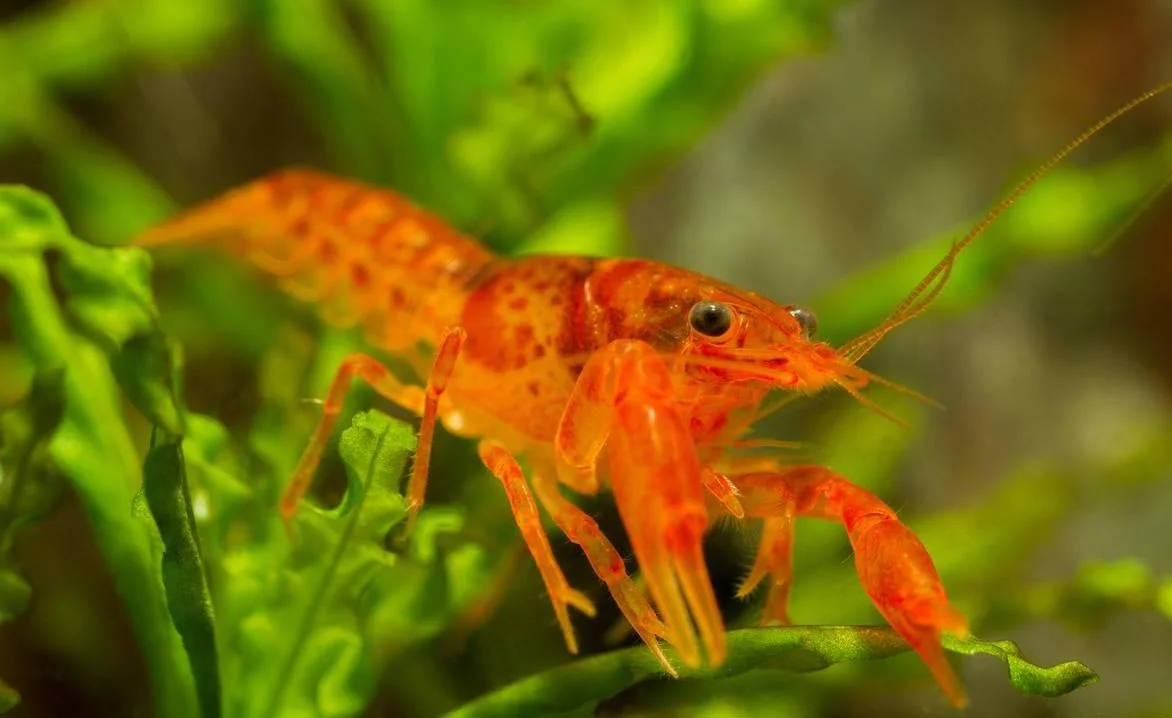
Cambarellus patzcuarensis "Orange" commonly called CPOs
CPOs (Cambarellus patzcuarensis "Orange") are bright orange dwarf crayfish native to Mexico. They grow to about 1.6 inches (4 cm), thrive in freshwater aquariums, and prefer temperatures of 68–78°F (20–26°C). They are peaceful hardy and will coexist with small fish and shrimp (for the most part) but may nip soft plants. They eat algae, biofilm, sinking pellets, and vegetables and have a Lifespan of about ~2 years. But! Can you keep dwarf crayfish with Vampire Crabs? It’s complicated! So let me explain!
Note: CPOs (Cambarellus patzcuarensis "Orange") are much smaller than Mexican dwarf crayfish, as both are the same species. The term "Mexican dwarf crayfish" is a general name for tiny crayfish, including CPOs, which are just the orange variety.
CAN YOU KEEP DWARF CRAYFISH WITH VAMPIRE CRABS?
While it might seem like a great pair-up for a paludarium mixing vampire crabs with dwarf crayfish is almost always a recipe for disaster. In almost all cases Geosesarma Vampire crabs will kill and eat drawf crayfish like CPOs. Vampire crabs are just bigger, stronger, better hunters, and far more aggressive. Unlike shrimp CPOs aren’t as quick to escape so they will quite easily be killed and eaten by vampire crabs. But! There is one Geosesarma species that might just work and it’s one that I have been experimenting with for the last 6 or so months. Below are my findings and the reasons why this particular species combination works.
KEEPING CAMBARELLUS PATZCUARENSIS ORANGE WITH GEOSESARMA NOTOPHORUM
Now you are probably wondering how this combination actually works…. So let me explain! Unlike pretty much all other Goesesarma Vampire Crab species Geosesarma Notophorum almost never ventures into the water as they have evolved to molt on land and stay hydrated using other methods. This means that there is almost no crossover between each species environments. The crabs will stay on the land and the crayfish will stay in the water.
Now it’s really important to note that while Geosesarma Notophorum almost never goes into the water, that doesn’t mean it doesn’t have the ability or option. It’s just highly unlikely for them to do so in really well designed ecosystem tanks. If you meet all of their requirements the inhabitants of your water section will remain safe and predator free. However! It’s also possible but again quite unlikely that your crayfish might venture onto land. While this doesn’t happen often there is always a possibility for both species to meet on the shoreline. If and when this happens the vampire cab will have the advantage and will more than likely jump on the chance for an easy meal.

A large male Geosesarma Notophorum
how to build an ecosystem to keep CAMBARELLUS PATZCUARENSIS ORANGE and GEOSESARMA NOTOPHORUM together?
As I mentioned above, how you create your paludarium will ultimately determine if you can keep both of these species together without the crayfish being eaten. Now remember I can’t stress enough that this only works for this particular species of Geosesarma. This will not work for all of the other Geosesarma species.
The main thing is to build your ecosystem in a very large and tall style tank. As Geosesarma Notophorum are an arboreal species they will spend a lot of their time in the upper parts of their environment. But they do occasionally also spend time on the ground in borrows, primarily the females. You also need to make sure that your population of crabs isn’t big enough for them to compete for space. If you have too many crabs the more dominant ones will force the less dominant ones into less ideal territory which might end up being the water section and shoreline.
As I mentioned at the very start I have been running this experiment for the last 6 months without any crayfish or crab losses and no close encounters that I have observed. That said! This doesn’t mean it is foolproof, as nature likes to get chaotic sometimes. So there’s always the possibility that one of my crabs decides it wants to spend a lot of time in the water section. And if that happens carnage might not be too far away.
Mexican Dwarf Crayfish – The Complete Practical Care Guide
If you’re looking for a really big deep dive into cambarellus patzcuarensis orange I highly suggest checking out Chris Lukhaup’s in depth guide on them. It’s one of the best and more accurate guides currently available and will teach you a lot about what to expect from this interesting species. While he doesn’t cover cohabitation with vampire crabs he goes into some of the risks of keeping them with fish and shrimp.